History of Social Psychology: Origins, Development, Major Theories & Key Thinkers
Updated: 24/09/2026
69
The History of Social Psychology explains how the scientific study of people’s thoughts, feelings, attitudes, and behavior in social situations developed into an established field of psychology. Human beings have always been interested in questions about friendship, cooperation, conflict, leadership, conformity, prejudice, group behavior, and social influence. The formal study of these questions developed much later through psychology, sociology, philosophy, and experimental research.
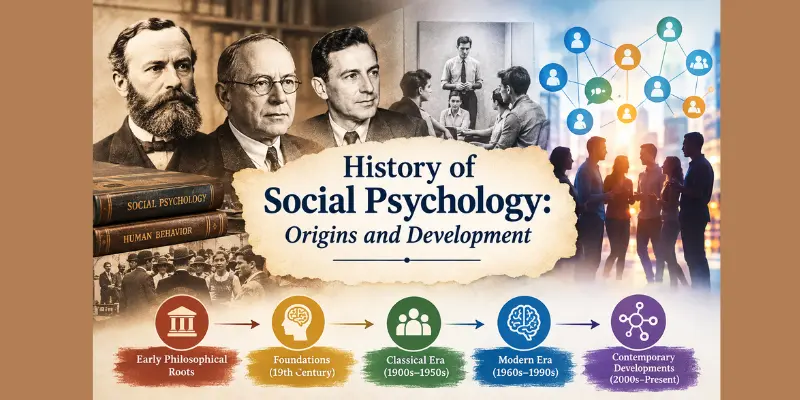
Social psychology examines how the presence of other people, real or imagined, can influence an individual’s behavior and mental processes. The field has developed from early observations of social behavior into a research-based discipline using experiments, surveys, longitudinal studies, field research, and statistical methods.
Understanding the History of Social Psychology also helps explain why concepts such as conformity, obedience, attitudes, social identity, group dynamics, interpersonal relationships, and social cognition are important today. Readers who want a broader introduction can also explore Social Psychology: Meaning, Importance & Child Development, which explains the basic meaning and relevance of the field.
What Is Social Psychology?
Social psychology is the scientific study of how people’s thoughts, feelings, attitudes, and behavior are influenced by other people and social situations. The field examines both individual psychological processes and the social environments in which those processes occur.
Common areas include social perception, attitudes, persuasion, conformity, obedience, group behavior, interpersonal relationships, prejudice, discrimination, social identity, cooperation, conflict, and helping behavior.
Social psychology is closely related to several other branches of psychology. It differs from social development in children, which focuses specifically on how children’s social abilities change as they grow. The distinction is important when studying the stages and skills of social development in children.
The field also connects with child psychology, cognitive psychology, personality psychology, developmental psychology, sociology, education, communication, and organizational behavior.
Early Ideas Behind the History of Social Psychology
The roots of social psychology existed before the discipline received its modern scientific identity. Philosophers and social thinkers had long examined human relationships, group behavior, leadership, morality, persuasion, and the relationship between individuals and society.
Ancient philosophical discussions considered why people cooperate, why groups develop rules, and how social environments influence human behavior. These ideas were not social psychology in the modern experimental sense, but they created intellectual questions that later psychologists could investigate scientifically.
The development of psychology as an independent scientific discipline during the nineteenth century created a stronger foundation for studying social behavior. Wilhelm Wundt and William James were among the important figures in the development of psychology as an academic science. OpenStax describes psychology as a relatively young science with experimental roots in the nineteenth century. OpenStax’s history of psychology provides additional background on this development.
The emergence of scientific psychology created opportunities to study social behavior through systematic observation and experimentation.
Norman Triplett and Early Experimental Social Psychology
Norman Triplett is frequently mentioned in discussions of the early History of Social Psychology. In 1898, Triplett published research concerning performance in the presence of others. His work is commonly associated with the early study of what later became known as social facilitation.
Triplett examined cycling records and conducted an experimental task involving competition and performance. His work became historically important because it represented an attempt to investigate social influence using empirical methods.
The traditional textbook account often describes Triplett’s 1898 research as the first social psychology experiment. Historical scholarship has challenged this simplified description. Researchers have pointed out that earlier studies could also be considered part of experimental social psychology and that some textbook descriptions of Triplett’s research are inaccurate.
This historical debate is useful because the History of Social Psychology is not a simple timeline with one universally accepted starting point. The field developed through multiple intellectual and scientific traditions.
Floyd Allport and the Scientific Study of Social Behavior
Floyd Henry Allport played an important role in establishing social psychology as a scientific field. His 1924 book Social Psychology became an influential work in the development of experimental social psychology.
Allport emphasized the study of individual behavior in social contexts and supported experimental and quantitative approaches. His work helped move social psychology toward systematic investigation of social stimuli, attitudes, group behavior, and individual responses.
The Syracuse University Archives describes Allport as a founder of social psychology who played an important role in establishing the discipline as a scientific field. His 1924 book had a significant influence on later social psychology writing.
This period represents an important stage in the History of Social Psychology because researchers increasingly attempted to define the field’s subject matter and scientific methods.
Social Psychology During the 1920s and 1930s
During the 1920s and 1930s, social psychology expanded beyond simple observations of social behavior. Researchers began studying attitudes, persuasion, group processes, public opinion, leadership, social influence, and interpersonal behavior.
Researchers developed methods for measuring attitudes and opinions. Survey research and attitude scales became important tools. Experimental approaches were also used to examine how social environments affected individual responses.
The relationship between psychology and sociology remained important during this period. Psychology often emphasized individual behavior and mental processes, while sociology focused more heavily on groups, institutions, and social structures. Social psychology developed between these perspectives.
The field also became increasingly interested in real-world social problems. Group relations, prejudice, leadership, work environments, conflict, and public attitudes became important research areas.
Kurt Lewin and the Development of Group Dynamics
Kurt Lewin is one of the most influential figures in the History of Social Psychology. His work connected individual psychology with social environments and group processes.
Lewin developed field theory and emphasized the importance of understanding behavior within its psychological environment. His work also contributed to action research and the systematic study of groups.
In the United States, Lewin became closely associated with group dynamics. Research associated with his tradition examined leadership, democratic participation, group decision-making, social change, and interpersonal relationships.
A scholarly review of Lewin’s work describes his contributions to field theory, action research, group dynamics, and sensitivity training. His work in the United States during the 1930s and 1940s helped establish group dynamics as an important area of research.
Lewin’s influence can still be seen in modern research involving teamwork, leadership, organizational behavior, education, community psychology, and social change.
The Impact of World War II on Social Psychology
World War II had a major influence on the development of social psychology. Questions about propaganda, prejudice, leadership, group behavior, morale, persuasion, and intergroup conflict became especially important.
Psychologists studied how attitudes could influence behavior and how social conditions could encourage cooperation or conflict. Researchers also examined prejudice and discrimination, including the psychological processes involved in relationships between social groups.
The practical demands of wartime research increased interest in applying psychological knowledge to real social problems. Social psychology became increasingly connected with communication, military research, public opinion, organizational settings, and community issues.
This period helped strengthen the idea that psychological research could be used to understand social problems outside the laboratory.
Muzafer Sherif and Social Norms

Muzafer Sherif made important contributions to the study of social norms and group influence. His research demonstrated how people can develop shared judgments when placed in uncertain social situations.
Sherif’s work on the autokinetic effect examined how people responded to an ambiguous visual situation. Individual judgments could shift toward a shared group norm when participants interacted with one another.
His research became an important part of the History of Social Psychology because it demonstrated that social groups can influence individual judgments and that group norms can develop through interaction.
The research contributed to later understanding of conformity, group decision-making, social influence, and intergroup relations.
Solomon Asch and Conformity Research
Solomon Asch’s conformity experiments became another major milestone in the History of Social Psychology. His research examined how individuals respond when their judgment conflicts with the apparent judgment of a group.
Participants were asked to compare line lengths. In some trials, other participants or confederates intentionally gave incorrect answers. The studies demonstrated that social pressure could influence an individual’s expressed judgment.
Asch’s work helped researchers understand conformity as a social influence process. It also encouraged further investigation into independence, group pressure, social norms, and the conditions that influence conformity.
The historical importance of conformity research remains visible in modern studies of peer influence, group behavior, classroom interaction, workplace decisions, and online communities.
Stanley Milgram and Obedience to Authority
Stanley Milgram’s obedience research became one of the best-known chapters in the History of Social Psychology. His experiments examined how people responded to instructions from an authority figure when those instructions conflicted with personal concerns.
Participants believed they were taking part in a learning experiment and were instructed to administer increasingly severe electric shocks to another person for incorrect answers. The apparent shocks were not actually delivered to the learner.
The research raised important questions about obedience, authority, personal responsibility, research methods, and research ethics. The APA Dictionary of Psychology describes Milgram’s work as an experimental study of individuals’ willingness to obey authority.
Milgram’s research remains influential, but it is also discussed alongside ethical questions concerning deception, participant distress, informed consent, and the responsibilities of researchers.
The Stanford Prison Experiment
The Stanford Prison Experiment, conducted in 1971, became another highly discussed event in the History of Social Psychology. Philip Zimbardo and colleagues created a simulated prison environment in which college students were assigned roles as prisoners or guards.
The study was intended to examine how social situations and institutional roles might influence behavior. It was stopped after six days because of serious concerns about participants’ experiences.
The American Psychological Association’s historical discussion describes the study as an investigation of the influence of social situations and institutional forces on behavior.
The study has also generated substantial methodological and ethical criticism. Modern discussions of the experiment consider questions about research design, interpretation, researcher involvement, participant behavior, and the limits of using the study as evidence for broad conclusions about human behavior.
Its place in the History of Social Psychology is therefore best understood as both historically influential and methodologically contested.
Leon Festinger and Cognitive Dissonance
Leon Festinger introduced cognitive dissonance theory in 1957. The theory became a major influence on social psychology by focusing attention on the discomfort associated with inconsistent cognitions.
Cognitive dissonance occurs when a person experiences inconsistency between beliefs, attitudes, knowledge, or behavior. People may attempt to reduce this inconsistency by changing an attitude, changing behavior, adding new explanations, or reinterpreting information.
Festinger’s work helped establish cognition as an important part of social psychological research. Research on dissonance examined persuasion, decision-making, attitude change, justification, and self-perception.
The theory was introduced in 1957 and became one of the widely studied concepts in social psychology.
Social Learning and Albert Bandura
Albert Bandura contributed to the development of social learning theory and expanded understanding of how people learn through observing others.
His work emphasized observational learning, modeling, imitation, reinforcement, and cognitive processes. People do not need to experience every consequence directly to learn from behavior. Observing another person’s actions and outcomes can influence later behavior.
This perspective became particularly relevant to child development. Children observe parents, teachers, siblings, peers, and media figures. Social environments can influence behavior through modeling and reinforcement.
Readers interested in the broader relationship between psychological processes and children’s development can also explore What Is Child Development?.
Social learning research helped connect social psychology with education, parenting, child psychology, behavior change, communication, and media research.
Social Identity Theory and Group Membership
Social identity theory became an important development in the later History of Social Psychology. Henri Tajfel and John Turner developed ideas explaining how people’s membership in social groups can contribute to their self-concept.
A person’s identity can include membership in groups based on culture, school, profession, interests, communities, or other social categories. Group membership can influence perceptions of oneself and others.
Research in this area examined processes such as categorization, identification, comparison, prejudice, and intergroup relations.
Social identity research expanded the field’s understanding of how individual psychological processes connect with group membership and social structures.
The Cognitive Revolution and Social Psychology
The cognitive revolution changed psychology’s approach to mental processes during the middle and later twentieth century. Researchers increasingly studied attention, memory, interpretation, judgment, information processing, and decision-making.
Social psychology incorporated these cognitive approaches into the study of social behavior. Researchers began asking how people interpret social information, form impressions, remember social experiences, explain other people’s behavior, and make judgments.
This development contributed to modern social cognition research.
The field increasingly examined concepts such as attribution, stereotypes, schemas, social comparison, impression formation, automatic processing, and judgment.
The development of cognitive psychology therefore became an important part of the broader History of Social Psychology.
Attribution Theory and Social Explanation

Attribution research examines how people explain the causes of behavior. Individuals may try to determine whether behavior resulted from personal characteristics or situational factors.
Researchers including Fritz Heider, Harold Kelley, and others contributed to the development of attribution research.
Attribution processes became important for understanding interpersonal relationships, workplace interactions, education, conflict, social judgment, and self-perception.
This area also connects naturally with child and adolescent development because children gradually develop more sophisticated ways of interpreting other people’s intentions, emotions, and behavior. Readers studying children’s broader psychological development can explore the Child Psychology Guide for related developmental concepts.
Social Psychology and Child Development
The History of Social Psychology has direct relevance to child development because children’s behavior develops within social environments.
Parents, caregivers, siblings, teachers, classmates, friends, and communities provide social experiences through which children observe behavior, learn expectations, develop relationships, and understand social rules.
Social psychology can help explain peer influence, conformity, cooperation, social comparison, group membership, interpersonal communication, and social learning.
Social development is a related but distinct topic. The Social Development in Children article focuses specifically on how children develop communication, cooperation, relationships, friendship skills, and participation in social environments.
Social and emotional development is another connected area. Children learn to understand emotions, respond to other people’s feelings, manage behavior, and develop relationships. The guide to social and emotional development provides a child-focused explanation of these processes.
How Social Psychology Research Methods Changed
Research methods have changed significantly throughout the History of Social Psychology.
Early researchers relied on observation, experimental tasks, surveys, and basic statistical analysis. Later researchers developed more sophisticated laboratory experiments and field studies.
Modern social psychology can use:
- Laboratory experiments
- Field experiments
- Surveys
- Interviews
- Longitudinal research
- Observational research
- Psychophysiological measures
- Statistical modeling
- Meta-analysis
- Digital and online behavioral data
Research ethics have also become an important part of psychological science. Studies involving deception, sensitive topics, vulnerable participants, or potentially stressful situations require careful ethical consideration.
The history of major experiments demonstrates why scientific evidence must be evaluated according to methodology, replication, context, and ethical standards.
How Modern Social Psychology Differs From Early Social Psychology
Early social psychology focused heavily on observable social behavior, attitudes, group processes, and interpersonal influence. Modern social psychology covers a much wider range of psychological and social processes.
Modern researchers examine how biological, cognitive, emotional, interpersonal, cultural, and environmental factors interact.
The field now addresses subjects such as:
- Social cognition
- Social identity
- Intergroup relations
- Prejudice and discrimination
- Persuasion
- Attitude change
- Group decision-making
- Interpersonal relationships
- Social influence
- Helping behavior
- Aggression
- Cooperation
- Cultural psychology
- Online social behavior
The modern field also uses more diverse populations and research settings than many classic studies.
Importance of the History of Social Psychology
Studying the History of Social Psychology provides more than a list of famous psychologists and experiments. It shows how scientific ideas develop, change, and sometimes become contested.
Historical knowledge helps readers understand why current theories exist and which questions motivated earlier researchers.
It also demonstrates the importance of research methodology. A famous experiment can influence an entire field while later research raises questions about its design or interpretation.
The history of the field provides lessons about replication, ethical research, measurement, cultural context, participant diversity, and responsible interpretation of evidence.
Major Milestones in the History of Social Psychology
A simplified timeline can help organize the major stages of development:
1898 — Norman Triplett: Early experimental work on social influence and performance became an important reference point in the field’s history, although scholars debate whether it should be called the first social psychology experiment.
1924 — Floyd Allport: His book Social Psychology helped establish an experimental and individual-focused approach to social psychology.
1930s–1940s — Kurt Lewin: Research on field theory, group dynamics, leadership, and social change contributed strongly to modern social psychology.
1930s–1950s — Muzafer Sherif: Research on social norms and group influence expanded understanding of how group contexts affect individual judgments.
1950s — Solomon Asch: Conformity research demonstrated the influence of group pressure on expressed judgments.
1957 — Leon Festinger: Cognitive dissonance theory placed psychological consistency and attitude change at the center of important social psychological research.
1960s — Stanley Milgram: Obedience research examined responses to authority and became a major part of social psychology’s history.
1971 — Stanford Prison Experiment: Research led by Philip Zimbardo examined social roles and situational influences and later became heavily debated in methodological and ethical discussions.
1970s onward — Social cognition and social identity: Researchers increasingly studied mental representations, group membership, social judgment, and information processing.
Modern era: Social psychology now incorporates cognitive, cultural, developmental, biological, technological, and interdisciplinary approaches.
What Can We Learn From the History of Social Psychology?

The History of Social Psychology demonstrates that human behavior cannot always be understood by examining individuals in isolation.
People interact with families, schools, workplaces, peer groups, communities, institutions, and cultures. These environments can shape attitudes, expectations, decisions, relationships, and behavior.
The field also demonstrates that social behavior is complex. A person’s actions can involve personal characteristics and situational factors at the same time.
Research history also shows why psychological findings should be interpreted carefully. Famous studies can provide valuable historical insights without automatically providing complete explanations of human behavior.
For students, parents, educators, researchers, and psychology readers, historical knowledge provides a foundation for understanding modern social psychological concepts.
FAQs About the History of Social Psychology
Who is considered the founder of social psychology?
There is no single universally accepted founder of social psychology. Floyd Allport played a major role in establishing an experimental approach, while Kurt Lewin became highly influential in group dynamics and social psychology. The field developed through contributions from many researchers.
When did social psychology begin?
The formal scientific development of social psychology took place mainly during the late nineteenth and early twentieth centuries. Norman Triplett’s 1898 research is frequently cited in textbook histories, but historians have challenged the idea that it was definitively the first social psychology experiment.
Why is 1898 important in the history of social psychology?
1898 is commonly associated with Norman Triplett’s research on performance in social and competitive settings. His study became a landmark in traditional accounts of experimental social psychology, although historical scholarship has questioned its status as the first experiment.
What did Kurt Lewin contribute to social psychology?
Kurt Lewin contributed to field theory, group dynamics, action research, leadership research, and the study of social change. His work strongly influenced experimental research involving groups and social environments.
Why are Milgram’s experiments important?
Milgram’s research examined obedience to authority and became an influential example of how social situations and authority pressure can affect behavior. The research also contributed to continuing discussions about psychological research ethics.
How is social psychology related to child development?
Social psychology examines psychological processes involved in social interaction, while child development examines how children’s abilities change over time. The two areas overlap when studying peer influence, relationships, social learning, cooperation, communication, and group behavior.
Why should students study the history of social psychology?
Studying the history of social psychology helps students understand how major theories and research methods developed. It also encourages critical thinking about evidence, methodology, ethics, cultural context, and the limits of psychological research.
Conclusion
The History of Social Psychology represents the development of a scientific field concerned with one of the most important aspects of human life: how people influence and respond to one another.
The field developed from early philosophical questions about individuals and society into systematic psychological research. Researchers such as Norman Triplett, Floyd Allport, Kurt Lewin, Muzafer Sherif, Solomon Asch, Leon Festinger, Stanley Milgram, Albert Bandura, and many others contributed to its development.
Classic research on social facilitation, group norms, conformity, obedience, cognitive dissonance, social learning, and social identity created foundations for modern research.
Contemporary social psychology continues to examine how individuals think, feel, communicate, cooperate, compete, form relationships, and behave within social environments. Its history remains valuable because it shows not only what researchers discovered but also how psychological science changes as evidence, methods, ethics, and perspectives develop.
Please Write Your Comments