Attribution Theory in Social Psychology: Meaning, Types, Examples & Biases
Updated: 17/09/2026
10
Attribution Theory in Social Psychology explains how people understand the causes behind human behavior and everyday events. When someone succeeds, fails, becomes angry, helps another person, or behaves unexpectedly, people naturally try to answer one question: Why did this happen?
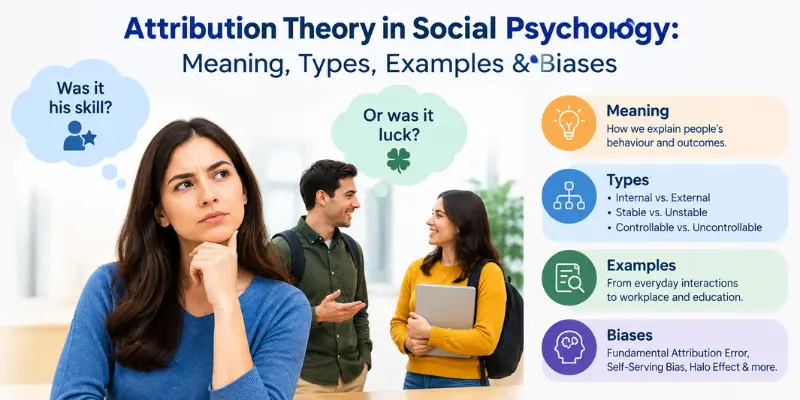
A person may explain success by saying that someone worked hard, had strong ability, or was naturally talented. Another explanation may focus on circumstances, such as an easy task, helpful support, good timing, or luck. These explanations are called attributions.
Understanding attribution is important because people do not always interpret behavior objectively. Their explanations can be influenced by incomplete information, previous experiences, expectations, relationships, culture, and personal interests. Learning about attribution can therefore improve the way people understand themselves and others.
For students interested in psychology, understanding social psychology and human behavior provides useful background for studying attribution. Attribution theory connects closely with social perception, interpersonal relationships, motivation, education, and child development.
What Is Attribution Theory in Social Psychology?
Attribution Theory in Social Psychology refers to the way people explain the causes of behavior and events. When people observe an action, they often make a judgment about what caused it.
For example, imagine a student receives a very high score on an examination. One person may explain the result by saying that the student studied consistently and has strong academic ability. This is an internal explanation. Another person may say that the examination was easier than expected or that the questions matched what the student had studied. This is an external or situational explanation.
The process is important because the explanation people choose can influence their future behavior. If a student believes success resulted from effort, the student may continue studying. If the student believes success happened only because the examination was easy, the effect on future motivation may be different.
Attribution theory therefore focuses not simply on what people do, but on how people interpret why the behavior happened.
The broader field of social psychology examines how people think about situations and how social circumstances influence behavior. OpenStax’s discussion of social psychology also distinguishes between situational and dispositional influences when explaining behavior. <a href=”https://openstax.org/books/psychology/pages/12-1-what-is-social-psychology“>OpenStax’s social psychology explanation</a> provides useful background for understanding these concepts.
Why Is Attribution Theory Important in Social Psychology?
Attribution theory is important because people constantly interpret the behavior of family members, friends, classmates, teachers, coworkers, and strangers.
Suppose a friend does not respond to a message. One explanation might be that the friend is ignoring you. Another possibility is that the friend is busy, travelling, dealing with a problem, or has not seen the message.
The first explanation focuses on the person’s characteristics. The second focuses on circumstances.
The difference matters because an attribution can affect emotions and behavior. Assuming that another person deliberately ignored you may create anger or disappointment. Considering possible situational causes may lead to a different response.
This connection becomes especially useful when studying social development in children. Children gradually learn how to interpret other people’s intentions, emotions, actions, and social situations. Their developing understanding of causes can influence friendships, classroom behavior, conflict resolution, and emotional responses.
Internal and External Attribution
One of the most important distinctions in attribution theory is between internal and external attribution.
Internal attribution explains behavior by referring to characteristics within the person. These may include personality, ability, effort, attitudes, intentions, or motivation.
For example:
- A student succeeds because they studied hard.
- An employee performs well because they are highly skilled.
- A child shares because they are considerate.
- A person arrives late because they are disorganized.
External attribution explains behavior through circumstances outside the person. These may include task difficulty, social pressure, environmental conditions, luck, timing, or other situational factors.
For example:
- A student succeeds because the test was easy.
- An employee performs well because the team provided excellent support.
- A child becomes upset because another child took their toy.
- A person arrives late because heavy traffic caused a delay.
Real-life behavior can involve both internal and external causes. A student may perform well because of preparation while also benefiting from favorable examination conditions.
OpenStax describes behavior as being influenced by both personal and situational factors rather than requiring every behavior to have only one type of explanation. <a href=”https://openstax.org/books/psychology-2e/pages/12-1-what-is-social-psychology“>This explanation of situational and dispositional influences on behavior</a> is useful when studying attribution.
Dispositional Attribution and Situational Attribution
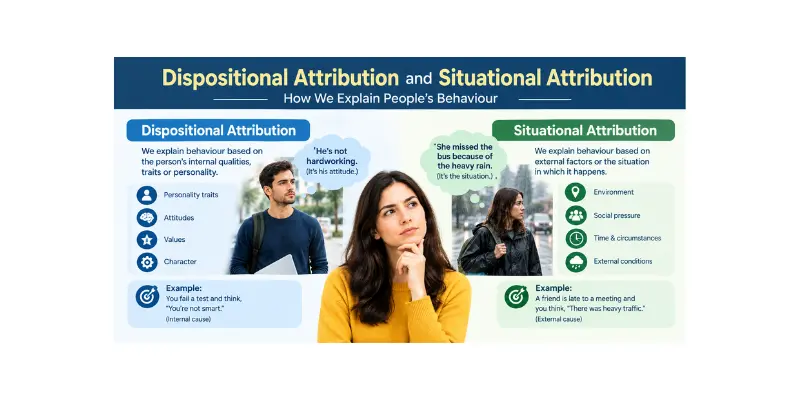
Dispositional attribution focuses on characteristics associated with the individual. It may involve personality, ability, temperament, motivation, or other relatively internal explanations.
Situational attribution focuses on circumstances surrounding the behavior.
Consider a child who refuses to participate in a classroom activity. A teacher could conclude that the child is lazy or uninterested. That is a dispositional interpretation. The teacher could also consider whether the activity is too difficult, whether the child is tired, whether the child feels anxious, or whether the instructions were unclear.
This does not mean that situational explanations are always correct. The purpose of attribution theory is to recognize that behavior can have multiple possible causes and that the available evidence should be considered before reaching a conclusion.
Fritz Heider and the Foundation of Attribution Theory
Fritz Heider is closely associated with the early development of attribution theory. His work focused on how ordinary people understand the causes of behavior.
Heider’s approach helped establish an important distinction between explanations based on the person and explanations based on the environment or situation.
A person observing another individual may not have direct access to that individual’s thoughts, intentions, or circumstances. The observer therefore uses available information to construct an explanation.
This process can be useful because people need to make sense of social behavior. It can also create errors when important information is missing.
Understanding what child development means can provide additional context for considering how children’s social understanding changes as they grow.
Harold Kelley’s Covariation Model
Harold Kelley expanded attribution research by examining how people use information when determining possible causes of behavior.
The covariation model is commonly associated with three types of information:
Consensus refers to whether other people behave similarly in the same situation.
Distinctiveness refers to whether the person behaves this way only in a particular situation or across different situations.
Consistency refers to whether the person behaves similarly in the same situation over time.
Imagine a student frequently complains about one particular teacher.
If many students complain about the teacher, consensus is high. If the student complains only about this teacher and not others, distinctiveness is high. If the student complains about the teacher repeatedly, consistency is high.
Looking at these patterns can help an observer consider whether the explanation should focus more on the person, the situation, or an interaction between them.
OpenStax’s discussion of attribution also describes consensus, consistency, and distinctiveness as information people may use when interpreting causes of behavior. <a href=”https://openstax.org/books/organizational-behavior/pages/3-3-attributions-interpreting-the-causes-of-behavior“>This OpenStax explanation of attribution and the covariation approach</a> provides additional detail.
Correspondent Inference Theory
Correspondent inference theory examines how people infer personal characteristics from another person’s behavior.
When a behavior appears intentional and distinctive, observers may be more likely to connect it with a characteristic of the individual.
For example, if someone voluntarily spends time helping elderly people, an observer might infer that the person is compassionate.
The important point is that an observer is moving from an observed behavior toward a conclusion about an underlying personal characteristic.
Such conclusions can sometimes be reasonable, but they can also be incomplete. A single behavior does not necessarily provide enough information to understand someone’s broader personality.
Fundamental Attribution Error
The fundamental attribution error is one of the best-known concepts associated with attribution theory. It describes the tendency to give too much weight to internal characteristics when explaining another person’s behavior while giving too little weight to situational influences.
For example, imagine a driver suddenly changes lanes in front of you. You might immediately think that the driver is careless or aggressive.
You may not know that the driver is trying to avoid an obstacle, responding to an emergency, or following an unfamiliar road.
The first explanation focuses on the driver’s disposition. The second considers the situation.
The concept is discussed extensively in social psychology. <a href=”https://openstax.org/books/psychology/pages/12-1-what-is-social-psychology“>OpenStax’s explanation of the fundamental attribution error</a> notes that people may overlook situational influences when explaining another person’s behavior.
The error does not mean that every internal explanation is wrong. It highlights the importance of considering situational information before making strong conclusions about another person’s character.
Actor-Observer Bias
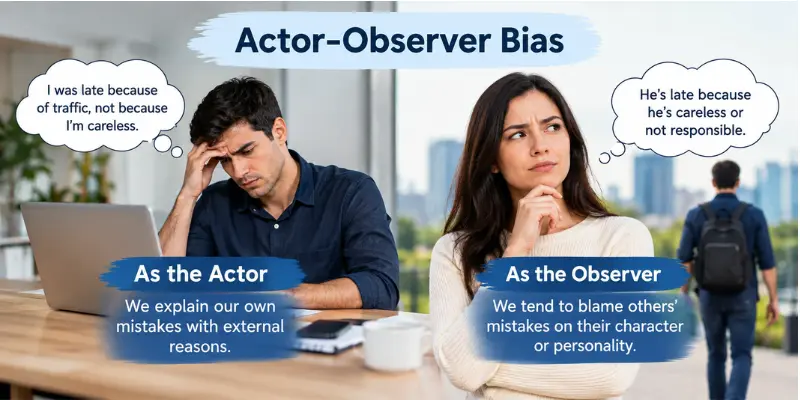
Actor-observer bias concerns differences between how people explain their own behavior and how they explain other people’s behavior.
When explaining our own actions, we often have access to information that other people cannot see. We know what happened before the behavior, what we were thinking, what pressures we experienced, and what circumstances affected us.
When explaining another person’s behavior, we may only see the final action.
For example, if you arrive late for work, you may explain that traffic was unusually heavy. If another employee arrives late, you might be more likely to describe them as irresponsible.
The difference demonstrates why having more information can influence attribution.
OpenStax identifies actor-observer bias as a pattern in which people may attribute others’ behavior more to internal causes while explaining their own behavior through situational forces. <a href=”https://openstax.org/books/psychology/pages/12-key-terms“>The OpenStax psychology key terms section</a> provides a concise definition.
Self-Serving Bias
Self-serving bias involves explanations that protect or maintain a favorable view of oneself.
A person may explain success through internal factors while explaining failure through external factors.
For example:
“I passed because I worked hard.”
“I failed because the examination was unfair.”
The first statement assigns success to an internal factor. The second assigns failure to an external factor.
This pattern can appear in education, sports, employment, and personal relationships. It does not mean that every explanation of success or failure is biased. The concept describes a tendency that can influence how people interpret outcomes.
OpenStax discusses self-serving bias alongside attribution dimensions such as internal versus external causes, stability, and controllability.
Attribution Theory Examples in Everyday Life
Attribution happens continuously in ordinary situations.
Example 1: Workplace performance
An employee completes a project before the deadline. A manager may attribute the performance to strong organizational skills. Another explanation could be that the employee had fewer assignments than usual or received significant assistance.
Example 2: Academic performance
A student receives a low grade. The student may believe that insufficient preparation caused the result. Another student may blame unclear questions or difficult examination conditions.
Example 3: Friendship
A friend cancels a meeting. One explanation is that the friend does not value the relationship. Another is that an unexpected family or work responsibility occurred.
Example 4: Parenting
A child becomes angry during homework. A parent might interpret the behavior as defiance. The child could instead be frustrated because the work is difficult.
These examples show why attribution theory is useful. The same behavior can produce very different interpretations depending on the information available to the observer.
Attribution Theory in Child Development
Attribution is relevant to child development because children learn to interpret why people behave in particular ways.
A young child may initially provide simple explanations for behavior. As cognitive and social understanding develops, children can become better able to consider multiple causes.
For example, a child may initially think that a classmate did not share a toy because the classmate is “mean.” A more developed explanation may consider whether the classmate was already using the toy, misunderstood the situation, or felt worried that someone would take it away.
This ability to consider different causes can support empathy, social problem-solving, and healthier interpersonal relationships.
Attribution is also relevant to children’s academic motivation. A child who believes poor performance results entirely from a fixed lack of ability may become discouraged. A child who understands the role of effort, strategies, practice, feedback, and task difficulty may interpret the same result differently.
Readers exploring cognitive development in children can examine the broader cognitive processes that contribute to how children understand information and experiences.
Attribution Theory and Social Perception
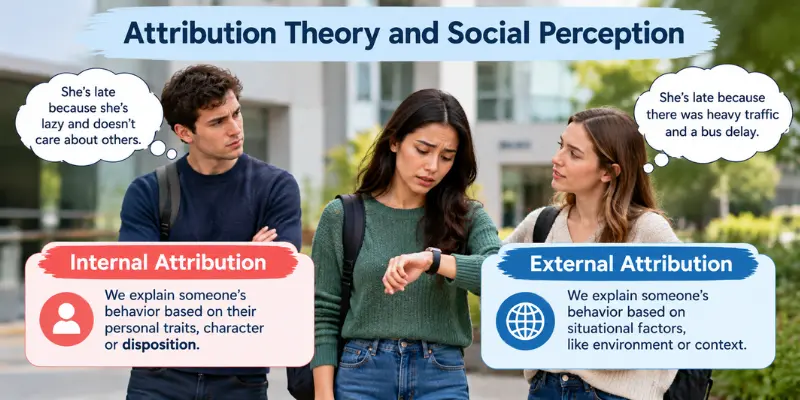
Social perception involves how people interpret other individuals and social situations.
Attribution is one part of this process because people often need to determine what another person’s behavior means.
Suppose a person walks past another person without saying hello. The observer may interpret the action as rude. Another possibility is that the person did not notice them.
The interpretation depends on available information.
This is why attribution theory connects closely with social cognition. People are not simply recording behavior like a camera. They are interpreting behavior and constructing explanations.
Attribution Theory and Relationships
Attribution can influence close relationships because people repeatedly explain each other’s behavior.
A partner who forgets an important date may be described as careless, or the behavior may be interpreted as the result of stress, workload, or another circumstance.
Repeated negative dispositional explanations can influence how people perceive one another. If every mistake is interpreted as evidence of a permanent personality problem, conflict may increase.
More balanced attribution involves considering patterns, circumstances, intentions, and available evidence.
This does not require ignoring repeated harmful behavior. It means distinguishing between an isolated action and a consistent pattern before assigning broad personal conclusions.
Attribution Theory in Education
Attribution theory has important applications in education.
Teachers make judgments about student behavior, effort, participation, and academic performance. Students also develop explanations for their own successes and failures.
Consider two students who receive the same low examination grade.
Student A thinks, “I did not understand the material, so I need a better study strategy.”
Student B thinks, “I am simply bad at this subject.”
These explanations can lead to different responses.
The first explanation identifies a potentially changeable factor. The second may create a more fixed interpretation of ability.
Teachers can help students develop realistic explanations by providing specific feedback about preparation, learning strategies, practice, understanding, and areas requiring improvement.
Attribution should not be used to blame students for every academic problem. Teaching quality, learning resources, classroom environment, assessment design, family circumstances, and other situational factors can also affect educational outcomes.
Attribution Theory and Motivation
Attribution can influence motivation because explanations affect expectations about future outcomes.
If a student believes improvement is possible through effective strategies and practice, the student may be more willing to continue working.
If a student believes failure proves permanent inability, motivation may decline.
This relationship makes attribution especially relevant to educational psychology and achievement motivation.
A useful approach is to distinguish between factors that are relatively stable and factors that may change. Ability, effort, task difficulty, strategy, support, and circumstances can interact in complex ways.
The goal is not to force every outcome into an “effort” explanation. Some difficulties are genuinely caused by external conditions. Accurate attribution requires attention to evidence.
Common Attribution Biases
Several attribution-related biases can affect how people interpret behavior.
Fundamental attribution error involves overemphasizing dispositional explanations for another person’s behavior while underestimating situational influences.
Actor-observer bias involves differences between explanations for one’s own behavior and explanations for another person’s behavior.
Self-serving bias involves explanations that tend to protect one’s favorable self-image, such as taking internal credit for success and assigning failures to external circumstances.
These concepts are related but should not be treated as identical. Each describes a different pattern in how people may interpret causes.
How to Apply Attribution Theory More Carefully
Attribution theory is most useful when it encourages people to examine evidence before reaching conclusions.
When someone behaves unexpectedly, ask:
What exactly happened?
Separate the observable behavior from the interpretation.
What internal explanations are possible?
Consider personality, ability, motivation, intentions, and previous behavior.
What situational explanations are possible?
Consider environment, social pressure, timing, task difficulty, stress, resources, and other circumstances.
Do I have enough information?
A single event may not provide enough evidence to make a broad judgment about a person’s character.
Has this behavior occurred repeatedly?
Repeated patterns provide different evidence from isolated incidents.
Could more than one cause be involved?
Human behavior often results from interactions between individual characteristics and environmental circumstances.
This approach does not eliminate attribution errors completely, but it can encourage more careful social reasoning.
Attribution Theory vs Social Learning Theory
Attribution theory and social learning theory both help explain human behavior, but they focus on different processes.
Attribution theory focuses on how people explain the causes of behavior and events.
Social learning theory focuses more broadly on how people learn through observation, interaction, modeling, and consequences.
For example, if a child observes another child receiving praise for helping a classmate, social learning concepts can help explain how the observation may influence future behavior.
Attribution theory can help explain how the child interprets the behavior and its outcome.
The theories can therefore address different aspects of the same social experience.
Limitations of Attribution Theory
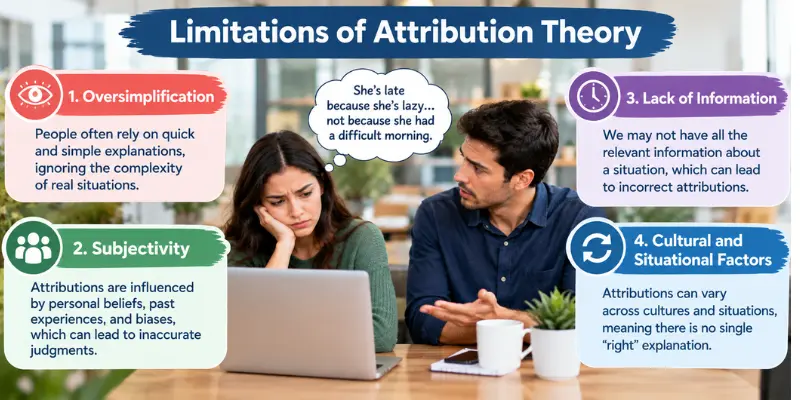
Attribution theory provides a useful framework, but human behavior is more complicated than a simple internal-versus-external distinction.
People may lack important information about a situation. Cultural expectations can influence explanations. Emotions can affect interpretation. Previous experiences can shape expectations. Different observers can interpret the same event differently.
Research also indicates that attribution biases are not equally expressed in every cultural context or situation. OpenStax notes differences associated with individualistic and collectivistic cultural contexts when discussing the fundamental attribution error.
Attribution theory should therefore be used as a framework for examining explanations rather than as a formula that automatically identifies the true cause of every behavior.
Frequently Asked Questions About Attribution Theory in Social Psychology
What is Attribution Theory in Social Psychology?
Attribution Theory in Social Psychology explains how people interpret the causes of behavior and events. People may attribute behavior to internal characteristics, external circumstances, or a combination of factors.
What are the two main types of attribution?
The two broad categories are internal attribution and external attribution. Internal attribution focuses on characteristics of the person, while external attribution focuses on circumstances surrounding the behavior.
What is an example of attribution theory?
If a student gets a high grade, someone may say the student worked hard. Another person may say the examination was easy. These are different explanations for the same outcome.
What is the fundamental attribution error?
The fundamental attribution error refers to the tendency to overemphasize personal characteristics when explaining another person’s behavior while underestimating situational influences.
What is actor-observer bias?
Actor-observer bias describes a tendency to explain other people’s behavior more through internal factors while explaining one’s own behavior more through situational factors.
What is self-serving bias?
Self-serving bias refers to a tendency to explain positive outcomes through internal factors and negative outcomes through external factors, although this pattern can vary by context.
Why is attribution theory important in child development?
Attribution helps explain how children interpret the causes of their own behavior and other people’s behavior. These interpretations can influence social relationships, emotional responses, learning, and motivation.
How is attribution theory used in education?
Teachers and students can use attribution concepts to examine explanations for academic success and failure. Considering effort, strategies, task difficulty, support, and circumstances can provide a more complete understanding of educational outcomes.
Final Thoughts on Attribution Theory in Social Psychology
Attribution Theory in Social Psychology helps explain one of the most common activities in human life: trying to understand why people behave the way they do.
People may explain behavior through personality, ability, effort, intention, circumstances, task difficulty, social pressure, or other factors. The challenge is that observers rarely have complete information.
Fundamental attribution error, actor-observer bias, and self-serving bias demonstrate how interpretations can become distorted. Understanding these concepts can encourage people to pause before making broad conclusions about another person’s character.
Attribution theory is particularly relevant to education, relationships, child development, motivation, and everyday social interaction. A more careful approach considers both the person and the situation, examines available evidence, and recognizes that complex behavior may have multiple causes.
For readers studying psychology, attribution theory provides a practical way to understand how explanations shape social perception and human interaction. It also connects naturally with broader topics such as child psychology and human behavior, social development, and cognitive development.
Please Write Your Comments