Nature and Scope of Social Psychology
Updated: 17/09/2026
14
The Nature and Scope of Social Psychology explains how people think, feel, and behave in the presence of other people and within different social situations. Human behavior is rarely shaped by personal characteristics alone. Family relationships, friendships, peer groups, social expectations, cultural surroundings, communication, and immediate situations can all influence the way people respond to the world around them.
Social psychology provides a scientific framework for understanding these influences. The American Psychological Association describes social psychology as a field concerned with interpersonal and group relationships and their influence on human behavior. Social psychologists study social influence, social perception, and social interaction at both individual and group levels.
A student may behave differently while studying alone, participating in a classroom, talking with close friends, or joining a large group. The situation, the people present, the person’s expectations, and previous experiences can all affect behavior. OpenStax explains that social psychology examines how social situations influence thoughts, feelings, and behavior and considers both individual and interpersonal processes.
Understanding the Nature and Scope of Social Psychology is useful for students of psychology, education, child development, sociology, communication, and behavioral science. It also helps explain everyday subjects such as friendship, cooperation, persuasion, group behavior, attitudes, social pressure, prejudice, and interpersonal relationships.
For readers who want a broader introduction to the discipline, Major Branches of Psychology provides an overview of psychology’s different areas and applications.
What Is Social Psychology?
Social psychology is the scientific study of how people are affected by other people and by social situations. It examines how individuals perceive themselves and others, form attitudes, respond to social expectations, build relationships, participate in groups, and influence one another.
The APA Dictionary of Psychology describes social psychology through the study of how an individual’s thoughts, feelings, and actions are affected by the actual, imagined, or symbolically represented presence of other people.
The Nature and Scope of Social Psychology therefore includes both internal psychological processes and observable social behavior. A person’s beliefs may affect how they interpret another person’s actions. Their interpretation may influence emotions, and those emotions can influence subsequent behavior.
Social psychology does not assume that every person will react in exactly the same way to the same situation. Individual experiences, personality, cultural background, expectations, and the characteristics of the situation can produce different responses.
This makes social psychology particularly useful for examining situations in which individual behavior and social circumstances interact.
Nature of Social Psychology
The nature of social psychology is scientific, social, behavioral, and contextual. Researchers use systematic methods to investigate how people behave in social situations rather than relying only on everyday assumptions.
A major characteristic of the Nature and Scope of Social Psychology is its focus on the individual within a social environment. Social psychologists may study one person’s perception of another person, interactions between two people, or behavior within a larger group.
Social psychology also examines the power of situations. A person’s behavior can change when the surrounding environment changes. OpenStax explains that modern approaches consider both situational and individual influences when examining human behavior.
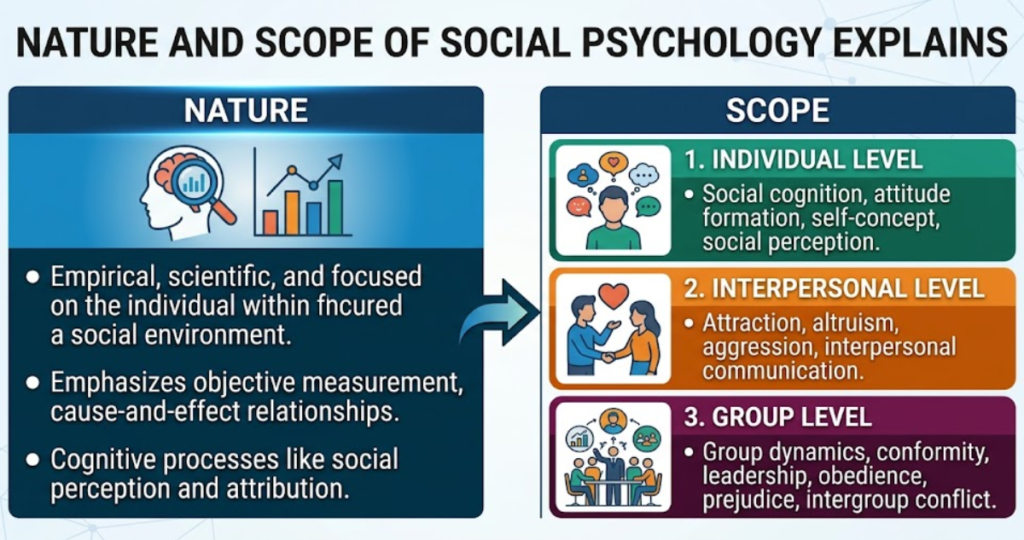
The field also connects thoughts, feelings, and behavior. Attitudes contain cognitive, emotional, and behavioral components, while social experiences can influence how people interpret information and respond to other people. OpenStax identifies attitudes and persuasion as major areas of social psychological research.
Social psychology is therefore not limited to studying large groups. It can examine a single interpersonal interaction, a friendship, a classroom, a workplace team, or relationships between larger social groups.
Scope of Social Psychology
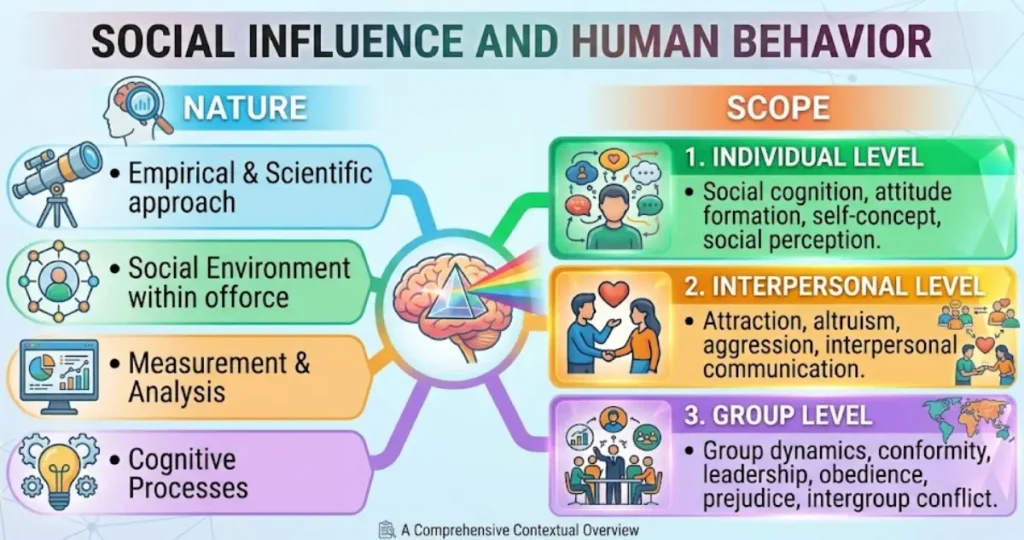
The scope of social psychology is broad because social interaction occurs throughout human life. The Nature and Scope of Social Psychology includes social cognition, attitudes, social influence, interpersonal relationships, group behavior, persuasion, prejudice, discrimination, cooperation, aggression, and helping behavior.
Social cognition examines how people process information about themselves and other people. Social perception is concerned with how people use another person’s behavior to form opinions or make inferences about that person’s motives, attitudes, or values.
Attitudes are another important area. People develop evaluations of ideas, objects, individuals, and social issues. These attitudes may influence behavior, while communication can sometimes change attitudes through persuasion. OpenStax identifies persuasion as a major area within social psychology and explains that communication can influence attitudes and beliefs.
Social influence is equally important. People may adjust their behavior because of group expectations, social norms, perceived authority, expertise, or the desire to fit into a particular social environment. APA educational material on social psychology discusses how individuals and groups can influence behavior through roles, norms, attitudes, responsibilities, and social expectations.
Group behavior extends this scope further. Researchers can examine leadership, cooperation, competition, group decision-making, group identity, conformity, and relationships between groups. These topics show why the Nature and Scope of Social Psychology extends from everyday interpersonal interactions to complex group processes.
Social Cognition and Social Perception
People constantly interpret social information. When someone enters a classroom, joins a conversation, meets a new person, or observes a friend’s reaction, the brain processes information about the social environment.
Social cognition examines these mental processes. People form impressions, remember previous interactions, interpret facial expressions, make judgments, and attempt to understand other people’s intentions.
Social perception is closely related. It involves using another person’s behavior to form opinions or make inferences about motives, attitudes, or values.
These processes are important because people do not respond only to what happens. They also respond to how they interpret what happens.
A student who interprets a teacher’s correction as helpful guidance may respond differently from a student who interprets the same correction as criticism. The event is similar, but the interpretation can produce a different emotional and behavioral response.
This relationship between social situations and individual interpretation is an important part of the Nature and Scope of Social Psychology.
Social Influence and Human Behavior
Social influence refers to the ways in which people affect the attitudes, decisions, emotions, or behavior of other people.
Conformity is one example. A person may change behavior to align with the expectations of a group. Social pressure can also involve persuasion, approval, authority, expectations, or direct requests.
APA’s educational material explains that people may adjust their behavior to fit into a group or respond to perceived expertise and authority.
Social influence can occur in families, schools, workplaces, friendships, communities, and online environments. It can involve positive behaviors such as cooperation and support, as well as harmful processes such as prejudice or unhealthy peer pressure.
Understanding social influence is therefore essential when studying the Nature and Scope of Social Psychology.
Attitudes, Persuasion, and Social Behavior
Attitudes represent evaluations of people, ideas, objects, or situations. They can involve thoughts, feelings, and behavioral tendencies.
Social psychologists study how attitudes form, how they are maintained, and how they may change. Persuasion is particularly important because people encounter persuasive communication in education, advertising, personal relationships, media, and everyday conversations.
OpenStax explains that persuasion involves changing an attitude through communication and describes different routes through which persuasive messages can influence people.
The study of attitudes and persuasion demonstrates the practical Nature and Scope of Social Psychology. Understanding how people process messages can be useful in education, communication, health campaigns, marketing, leadership, and interpersonal relationships.
Group Behavior and Interpersonal Relationships
Human beings participate in groups throughout life. Families, classrooms, friendship circles, sports teams, workplaces, communities, and online groups all create social environments.
Within groups, people may adopt roles, follow norms, cooperate with others, compete for resources, develop shared identities, and respond to group expectations.
Interpersonal relationships are another major part of the Nature and Scope of Social Psychology. Friendship, attraction, trust, communication, cooperation, conflict, and social support can all be studied from a social psychological perspective.
Children develop social relationships through repeated interactions with parents, caregivers, siblings, teachers, classmates, and friends. Readers interested specifically in children’s relationships and social skills can explore Social Development in Children, which focuses on developmental changes in communication, cooperation, friendships, group participation, and social skills.
The distinction is useful for SEO as well as subject clarity: social psychology studies the psychological processes behind social interaction, while the child-development article focuses specifically on how children’s social abilities develop over time.
Social Psychology and Child Development
The Nature and Scope of Social Psychology has a strong connection with child development because children grow within social environments.
Family interactions, classroom experiences, friendships, peer relationships, and community experiences provide opportunities for children to observe behavior, communicate, cooperate, negotiate, and develop an understanding of other people’s perspectives.
Social psychology and child development are related but they have different primary focuses. Child development examines changes across areas such as cognitive, physical, emotional, language, and social development. Social psychology concentrates more directly on social influence, interaction, perception, relationships, attitudes, and group behavior.
The distinction can be seen in What Is Child Development?, which explains development as a broader process involving cognitive, physical, emotional, language, and social abilities.
Children’s social and emotional abilities also overlap with social psychological concepts. What Is Social and Emotional Development? discusses children’s ability to understand emotions, manage behavior, communicate, cooperate, develop relationships, and respond to social situations.
These related subjects should not be treated as identical. They address different questions even when they examine similar social experiences.
Social Psychology During Adolescence
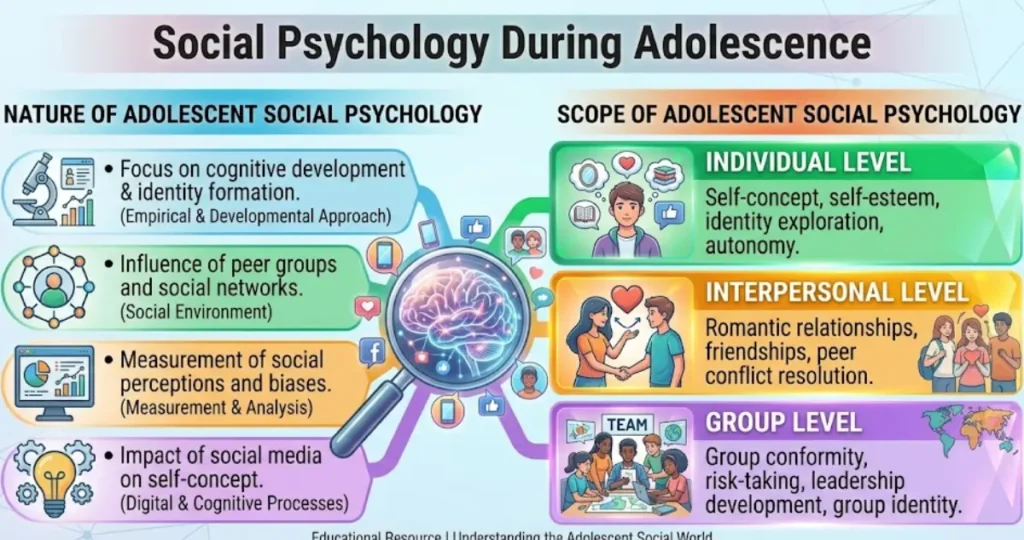
Adolescence provides many examples of the Nature and Scope of Social Psychology because peer relationships, social identity, group membership, independence, and social expectations become increasingly complex.
Adolescents interact with friends, classmates, teachers, family members, and wider communities. They may encounter different expectations in each environment and may adapt their behavior according to the social situation.
Social psychological research can examine how adolescents interpret social information, respond to peer influence, form relationships, and develop attitudes.
Developmental psychology adds another perspective by examining how these abilities change with age. The two fields therefore overlap while maintaining different research questions.
Major Applications of Social Psychology
The applications of social psychology extend into education, family relationships, organizations, communication, health, marketing, community programs, and conflict management.
In education, knowledge of social influence and group behavior can help explain classroom interaction, cooperation, peer relationships, participation, and communication. In workplaces, social psychological concepts can be applied to teamwork, leadership, communication, group decision-making, and workplace relationships.
The field also contributes to understanding communication and persuasion. Social psychological research can help explain why people respond differently to messages depending on the source, content, audience, and context.
Social psychology can also contribute to understanding prejudice and interpersonal conflict. The APA notes that research into social perception, social interaction, and social influence can provide insight into relationships and harmful attitudes such as prejudice.
For students who want to understand how psychology is divided into different fields, Types of Psychology provides a broader overview. This article keeps its focus on the Nature and Scope of Social Psychology rather than attempting to explain every branch of psychology.
Research Methods in Social Psychology
The scientific nature of the field means that research methods are an important part of the Nature and Scope of Social Psychology.
Researchers may use experiments to examine relationships between variables under controlled conditions. Surveys can measure attitudes, beliefs, perceptions, and reported behavior. Observational research can examine behavior in natural or structured settings.
Interviews may provide detailed information about people’s experiences and interpretations. Correlational research can identify relationships between variables, although correlation by itself does not establish causation.
The choice of method depends on the research question, population, setting, ethical considerations, and type of evidence required.
Scientific research is particularly important in social psychology because people’s everyday explanations of behavior can be incomplete. A person may attribute another person’s behavior to personality while overlooking the influence of the situation. OpenStax discusses this distinction between situational and dispositional explanations of behavior.
Levels of Analysis in Social Psychology
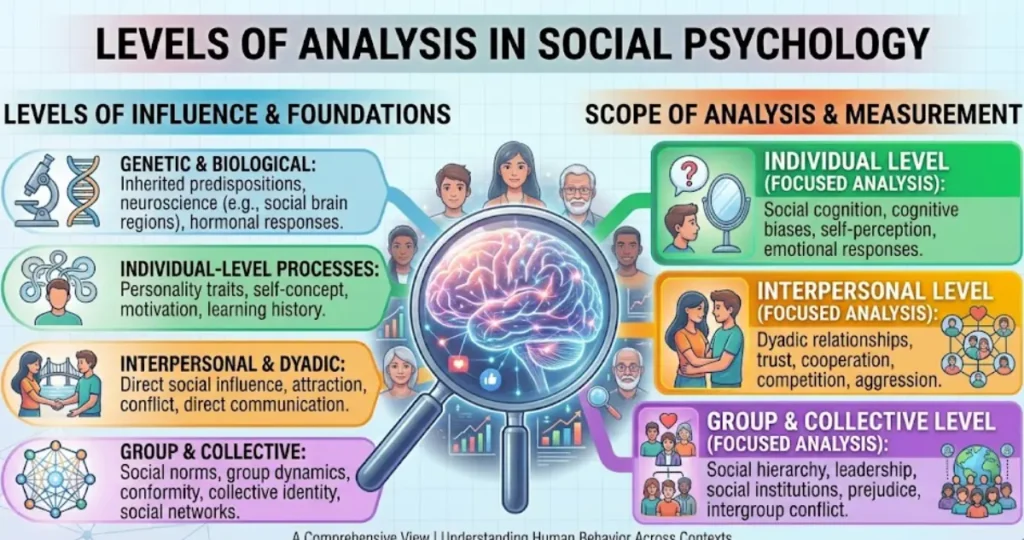
The Nature and Scope of Social Psychology can be examined at different levels.
At the individual level, researchers may examine attitudes, emotions, social cognition, self-concept, motivation, and perceptions.
At the interpersonal level, researchers examine interactions between individuals. Friendship, attraction, cooperation, communication, helping, and conflict can be studied at this level.
At the group level, researchers examine norms, roles, leadership, decision-making, cooperation, competition, and group identity.
At the intergroup level, researchers study relationships between social groups, including prejudice, discrimination, competition, cooperation, and social identity.
These levels can interact. A person’s individual beliefs can influence group behavior, while group membership can influence individual attitudes and decisions.
Social Psychology and Other Psychology Fields
The Nature and Scope of Social Psychology overlaps with developmental, cognitive, personality, educational, and organizational psychology.
Developmental psychology focuses on changes across the lifespan, while social psychology examines social influence and interaction.
Cognitive psychology focuses on processes such as memory, attention, perception, learning, and reasoning. Social psychology considers many of these processes within social contexts.
Readers interested in children’s thinking and learning can explore Cognitive Development, which focuses specifically on how children develop abilities related to learning, thinking, memory, reasoning, and problem-solving.
Personality psychology focuses on individual differences and relatively stable patterns of behavior, while social psychology places greater emphasis on social situations and interactions.
Sociology also overlaps with social psychology, but sociology generally focuses more heavily on social structures, institutions, organizations, and broader patterns of society.
Importance of Social Psychology
Understanding the Nature and Scope of Social Psychology helps people examine everyday interactions using psychological concepts rather than relying only on assumptions.
The field can help explain why people behave differently in groups, how attitudes develop, how social pressure works, why people cooperate, how relationships develop, and how people form impressions of others.
For educators and parents, social psychology can provide a framework for understanding social environments around children. For students, it provides a foundation for further study of human behavior and related disciplines.
For researchers and professionals, it provides concepts and research methods for examining social interaction in different settings.
The importance of the field comes from its broad relevance to situations in which people interact with one another.
Limitations of Social Psychology
The Nature and Scope of Social Psychology is broad, but social psychological findings should be interpreted according to the evidence available.
Human behavior is influenced by multiple factors. Personality, development, culture, relationships, biology, social circumstances, and immediate situations can interact.
A study involving one population may not automatically apply to every culture or age group. Laboratory research provides control over variables but may differ from everyday environments. Surveys can provide valuable information about attitudes and reported experiences, but self-reported responses may not always represent actual behavior.
Research findings therefore need to be considered in relation to the sample, research design, setting, measurement methods, and limitations.
This evidence-based approach is an important part of the scientific Nature and Scope of Social Psychology.
Academic and Career Scope of Social Psychology

The academic scope of social psychology includes areas such as social cognition, attitudes, social influence, group behavior, interpersonal relationships, persuasion, prejudice, cooperation, and research methodology.
Students can encounter social psychology within psychology degree programs and related areas such as behavioral science, communication, education, organizational studies, and social research.
Career opportunities depend on educational qualifications, professional specialization, licensing requirements, and the regulations of the country in which a person intends to work.
The APA notes that social psychologists study how individuals think about, influence, and relate to one another and may research topics including group behavior, attitudes, leadership, friendship, persuasion, prejudice, and aggression.
This makes the Nature and Scope of Social Psychology relevant not only to academic study but also to professional areas involving human interaction.
Frequently Asked Questions About Nature and Scope of Social Psychology
What is the nature of social psychology?
The nature of social psychology is scientific and research-based. It examines how individuals’ thoughts, feelings, attitudes, and behavior are influenced by other people and by social situations.
What is the scope of social psychology?
The scope includes social cognition, social perception, attitudes, persuasion, social influence, group behavior, interpersonal relationships, prejudice, discrimination, aggression, cooperation, and helping behavior.
Why is social psychology important?
Social psychology helps explain how people respond to social situations, groups, relationships, communication, and social expectations. Its concepts can be applied in education, workplaces, relationships, communication, and community settings.
How is social psychology related to child development?
Social psychology examines social influence and interaction, while child development examines how children change across different developmental domains. The two fields overlap because children’s development occurs within relationships and social environments.
What methods are used in social psychology?
Social psychologists use experiments, surveys, observations, interviews, correlational studies, and other systematic research methods depending on the research question.
What are the major topics in social psychology?
Major topics include social cognition, social perception, attitudes, persuasion, social influence, group processes, interpersonal relationships, prejudice, discrimination, aggression, cooperation, and prosocial behavior.
Conclusion
The Nature and Scope of Social Psychology covers the scientific study of how people think, feel, and behave within social contexts. The field examines both individual psychological processes and the influence of relationships, groups, social expectations, and situations.
Its scope includes social cognition, social perception, attitudes, persuasion, social influence, interpersonal relationships, group behavior, prejudice, cooperation, aggression, and helping behavior. These areas explain many forms of everyday human interaction.
Social psychology also has an important relationship with child development. Children learn and develop through relationships with caregivers, teachers, siblings, friends, classmates, and wider communities. The social-development articles on ChildToAdult address the developmental side of these experiences, while this article focuses on the broader academic Nature and Scope of Social Psychology.
The subject has applications in education, communication, organizations, relationships, community programs, research, and other settings where human interaction takes place.
Please Write Your Comments