What Is Conformity in Social Psychology? Meaning, Types & Examples
Updated: 07/10/2026
11
Conformity in social psychology refers to the process through which a person changes their behavior, opinions, judgments, attitudes, or actions to become more consistent with those of other people or with the expectations of a social group. The APA Dictionary of Psychology describes conformity as adjusting opinions, judgments, or actions so that they become more consistent with other people or with the normative standards of a social group or situation.
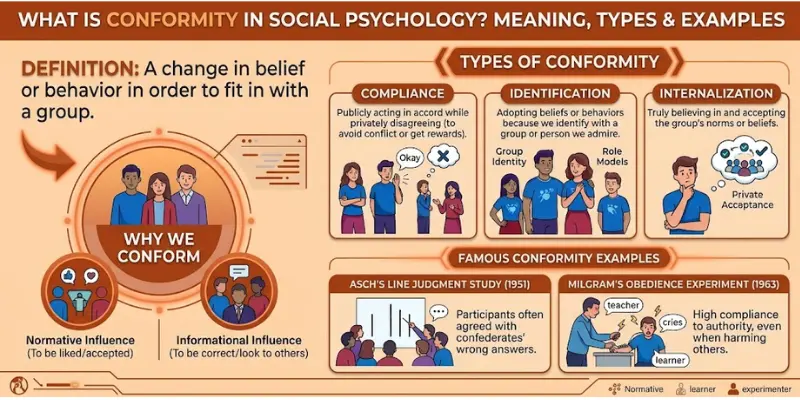
Conformity is one of the important concepts used to understand how social environments influence individual behavior. A person may conform because they want to be accepted, because they believe other people have better information, or because the situation creates pressure to follow an established social norm.
Conformity is a normal part of social life. People encounter it at home, in schools, workplaces, friendship groups, communities, cultural settings, and online spaces. Someone may change the way they dress because of a social group, agree with a popular opinion during a discussion, follow a classroom routine after observing classmates, or adopt a behavior because most people around them are doing it.
Conformity does not always mean that a person completely changes their beliefs. Sometimes a person publicly agrees with a group while privately maintaining a different opinion. In other situations, exposure to other people’s views can genuinely change what the person believes. This difference makes conformity an important subject within Social Psychology.
What Does Conformity Mean in Social Psychology?
In social psychology, conformity means adjusting one’s thoughts, attitudes, judgments, or behavior in response to real or perceived social pressure. The pressure does not always have to be direct. A person may never be told to change but may still notice what other people are doing and adjust their own behavior accordingly.
For example, imagine a student entering a classroom where everyone is quietly working. The teacher has not yet asked the student to remain silent, but the student sits down and begins working quietly after observing the group. This is a simple example of how social expectations can influence behavior.
Another example can occur during a group discussion. A person may initially disagree with the majority but decide not to express the disagreement because everyone else appears to support the same position. The person may conform publicly even though their private opinion remains unchanged.
Conformity is therefore broader than simply obeying an instruction. It involves alignment with group behavior, attitudes, judgments, or norms.
Why Is Conformity Important in Social Psychology?
Conformity is important because human behavior is strongly connected with the social environments in which people live. Social psychology examines how other people and social situations influence thoughts, feelings, attitudes, and behavior. Conformity provides one explanation for why individuals sometimes behave differently when they are alone compared with when they are surrounded by other people.
A person may make one decision independently and another decision after hearing a group discussion. A teenager may behave differently with close friends than with parents. An employee may express a different opinion privately than during a meeting where everyone else supports a particular proposal.
These situations demonstrate that individual behavior cannot always be understood without considering the social environment.
Conformity also helps explain social cooperation. Shared expectations allow people to coordinate their behavior. Everyday practices such as waiting in a line, following classroom rules, observing workplace procedures, or using socially accepted forms of communication depend partly on people recognizing and following social norms.
At the same time, conformity can create problems when group pressure discourages independent thinking or encourages harmful behavior. Understanding conformity helps psychologists examine both the benefits and risks of social influence.
Readers who want a broader understanding of the field can also explore the Nature and Scope of Social Psychology, while those interested in how social abilities develop specifically in children can read Social Development in Children.
How Does Conformity Work?
Conformity can occur through several psychological processes. A person first notices the behavior, opinion, or expectation of other people. The individual then evaluates the social situation and considers whether following the group might provide acceptance, information, safety, approval, or some other benefit.
The person may subsequently change their public behavior, private belief, or both.
The strength of conformity can depend on several conditions. A person may be more influenced when the group is important to them, when the group appears unanimous, when the individual feels uncertain, or when disagreement could produce embarrassment or rejection.
The situation also matters. Conformity is not equally strong in every environment. A person who feels confident about a subject may resist group pressure more easily than someone who believes the group has greater knowledge.
This is why conformity should not be viewed simply as a weakness or lack of independence. It is a complex form of social influence influenced by the person, group, situation, and perceived consequences.
What Are the Main Types of Conformity?
Psychologists commonly discuss conformity in relation to normative social influence and informational social influence. These two processes help explain why people may behave similarly even when their motivations are different.
Normative Social Influence
Normative social influence occurs when a person conforms because they want to fit in, gain acceptance, maintain relationships, or avoid social rejection. The person may recognize that the group is wrong but still decide to go along with the group.
For example, a student may laugh at a joke because everyone else is laughing even though the student does not find it funny. A teenager may adopt a particular style because friends consider it popular. An employee may remain silent during a discussion because disagreeing with colleagues feels uncomfortable.
Normative conformity is closely associated with the human need for belonging. People generally care about how they are perceived by others, particularly when the group is important to their identity or relationships.
A person influenced by normative pressure may change outward behavior without changing their private belief. The behavior can therefore disappear when the social pressure is removed.
Informational Social Influence
Informational social influence occurs when a person conforms because they believe other people have more accurate information or a better understanding of a situation.
This type of conformity is especially relevant when circumstances are uncertain or ambiguous. If a person does not know what to do, observing the behavior of others can provide useful information.
Imagine entering a building and noticing that everyone suddenly begins moving toward an exit. You may follow them because you assume they know something you do not. You are not necessarily trying to impress the group. You are using the group’s behavior as information.
Informational social influence can also occur in educational settings. A student who is uncertain about how to solve a difficult problem may observe classmates or listen to an explanation before changing their own approach.
In this situation, conformity can involve genuine acceptance of the group’s judgment because the individual believes the group may be correct. OpenStax Psychology identifies normative and informational social influence as two important motivations for conformity.
What Is the Difference Between Normative and Informational Conformity?
The main difference is the reason behind the behavior.
Normative conformity is primarily associated with the desire to belong, gain approval, or avoid rejection. Informational conformity is primarily associated with the desire to make an accurate decision when the situation is uncertain.
A person who agrees with friends because they do not want to feel excluded is showing normative social influence. A person who follows experienced colleagues because they believe those colleagues understand the situation better is showing informational social influence.
Both processes can produce similar outward behavior. The psychological motivation behind the behavior is different.
This distinction is important because two people may appear to conform in exactly the same situation while experiencing completely different psychological processes.
What Is the Asch Conformity Experiment?

One of the most famous demonstrations of conformity in social psychology comes from the experiments conducted by Solomon Asch during the 1950s.
In the classic line-judgment task, participants were shown a standard line and several comparison lines. The correct answer was generally clear. However, other people in the group were instructed to provide an incorrect answer on certain trials.
The important question was whether the genuine participant would maintain their own judgment or agree with the clearly incorrect majority.
The findings demonstrated that group pressure could influence individual judgments even when the correct answer was relatively obvious. OpenStax’s discussion of the Asch effect explains that the experiments demonstrated the influence of a group majority on an individual’s judgment.
The experiment became important because it showed that people do not always rely exclusively on their own perceptions when making judgments. Social pressure can influence publicly expressed answers.
The Asch research is particularly useful for understanding normative conformity. Some participants knew that the group’s answer was incorrect but still gave the same answer publicly to avoid standing apart from the group.
What Factors Increase Conformity?
Conformity can become stronger under certain social conditions. One important factor is group unanimity. When everyone else appears to agree, disagreeing with the group can feel more difficult.
Group size can also matter. A larger majority can create greater social pressure, although conformity does not continue increasing indefinitely simply because more people are added.
The importance of the group also influences conformity. People may be more willing to follow the expectations of close friends, family members, classmates, colleagues, or groups with which they strongly identify.
Uncertainty is another major factor. When people are unsure about what is correct, they may look to others for information.
Public responses can also increase social pressure. Expressing an opinion in front of other people can feel more socially risky than making the same decision privately.
The perceived status or expertise of group members can matter as well. People may be more likely to follow someone whom they consider knowledgeable, experienced, or trustworthy.
Does Group Size Affect Conformity?
Group size can influence conformity because a person may perceive a larger majority as stronger evidence of a social norm. When several people independently appear to support the same position, disagreement can become psychologically harder.
Research associated with the Asch paradigm showed that conformity increased as the majority grew to a point, after which additional members produced diminishing effects.
The quality of the majority also matters. A large group that appears divided may exert less pressure than a smaller group that appears completely unanimous.
This shows why simply counting the number of people in a group does not provide a complete explanation of conformity. Perceived agreement, group relationships, task difficulty, and social context all matter.
Why Do People Conform?
People conform for different reasons. The desire for social acceptance is one important explanation. Human beings often value belonging and relationships, so rejecting a group’s expectations can feel uncomfortable.
Another reason is uncertainty. When people do not know what is correct or appropriate, they may use other people’s behavior as a source of information.
People can also conform because social norms make behavior easier to coordinate. If everyone follows shared expectations, everyday interactions become more predictable.
Fear of rejection can also contribute. Someone may worry that disagreement will lead to criticism, embarrassment, exclusion, or conflict.
Personal identity can influence conformity as well. People may be especially motivated to follow the expectations of groups that are important to their sense of identity.
Cultural expectations also shape how conformity is understood. Some social environments place greater emphasis on group harmony and collective expectations, while others place stronger emphasis on individual independence.
What Are Everyday Examples of Conformity?
Conformity can be seen in many ordinary situations.
A student may begin raising their hand before speaking because other students follow that classroom expectation. A new employee may adopt workplace communication practices after observing colleagues. A person attending a formal event may change their clothing or behavior according to the expectations of the setting.
Friends can also influence conformity. Someone may begin listening to a particular type of music because their friendship group enjoys it. A person may choose a restaurant because everyone else in the group prefers it.
Online environments provide additional examples. People may use popular expressions, participate in online trends, adopt widely shared opinions, or change what they post based on reactions from other users.
Not every example represents unhealthy pressure. Many forms of conformity simply help people understand and participate in social environments.
What Are Examples of Conformity in Children?
Children experience conformity through family, school, friendships, sports, clubs, and other group settings.
A child may observe classmates putting their materials away and begin doing the same. Another child may start playing a particular game because friends are playing it. A student may change an answer after discovering that most classmates selected another option.
As children grow, peer relationships can become increasingly important. School-age children become more aware of acceptance, rejection, fairness, group expectations, and friendship. Adolescents may become particularly sensitive to peer opinions and social identity.
These examples should not automatically be interpreted as problems. Learning social expectations is part of normal social development. The concern arises when conformity becomes so strong that a child feels unable to express reasonable disagreement, establish boundaries, or resist harmful pressure.
For a broader developmental perspective, readers can explore Child Development and Social and Emotional Development.
Is Conformity Always Bad?
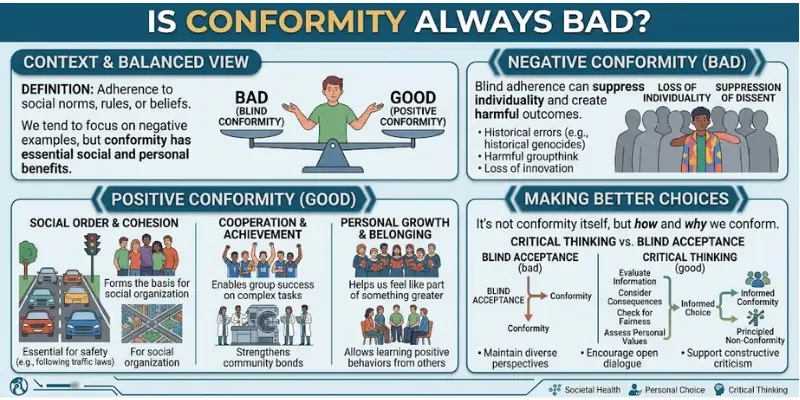
Conformity is not inherently good or bad. Its effects depend on what a person is conforming to, why they are doing it, and what consequences follow.
Positive conformity can support cooperation and social functioning. Following reasonable classroom rules can make learning easier. Observing appropriate workplace procedures can improve coordination. Following community norms can help people interact respectfully.
Conformity can also encourage positive behavior. A child may become interested in reading because friends enjoy books. A student may participate more actively because classmates encourage participation. A person may develop healthy habits after seeing people around them engage in those habits.
Negative conformity can occur when group expectations encourage harmful, dishonest, discriminatory, unsafe, or unethical behavior.
The important issue is therefore not simply whether someone conforms. The more useful question is whether the social influence supports healthy functioning, independent judgment, and appropriate values.
What Is the Difference Between Conformity and Compliance?
Conformity and compliance are related but not identical.
Conformity generally involves adjusting behavior, opinions, judgments, or attitudes to align with other people or group norms. Compliance usually refers to changing behavior in response to a request or demand.
For example, a person may wear clothing similar to their friends because they want to fit into the group. That is an example of conformity.
If a teacher asks a student to complete an assignment and the student does so because of the request, that is compliance.
The two concepts can overlap. A person may comply with a request because of social pressure, but not every act of compliance represents conformity. The APA Dictionary of Psychology’s definition of compliance distinguishes compliance from the broader concept of conformity.
What Is the Difference Between Conformity and Obedience?
Obedience involves responding to a direct command or instruction from an authority figure. Conformity is generally associated with aligning with the behavior, opinions, or norms of other people or a group.
For example, an employee following a manager’s direct instruction is an example of obedience. An employee changing their behavior because every colleague behaves in a certain way is closer to conformity.
The distinction is useful because different forms of social influence involve different psychological processes.
Conformity often concerns peers or groups. Obedience more directly involves authority.
What Is the Difference Between Conformity and Peer Pressure?
Peer pressure is a form of social influence in which peers encourage or pressure a person to behave in a particular way. Conformity is the broader psychological process of adjusting behavior, judgment, or attitudes toward group expectations.
Peer pressure can produce conformity, but not every instance of conformity involves direct peer pressure.
For example, a child may notice that classmates bring a certain type of notebook and decide to buy a similar one without anyone asking. That is conformity without obvious direct pressure.
If friends repeatedly encourage a child to participate in an activity the child does not want to join, the situation is more clearly described as peer pressure.
Can Conformity Affect Decision-Making?
Yes. Conformity can influence individual decision-making by changing how people evaluate available choices.
A person may reconsider an opinion after hearing that most people disagree. Someone may select a product because it is popular. A student may choose an answer because classmates appear confident about it.
Conformity can sometimes improve decisions when other people genuinely possess useful knowledge. In uncertain situations, learning from others can be beneficial.
It can also weaken decision-making when people suppress important information simply because they want to maintain agreement. Groups can make poor decisions when members become reluctant to challenge a consensus.
This is one reason independent thinking remains important within families, classrooms, organizations, and communities.
What Is Groupthink and How Is It Related to Conformity?
Groupthink is a group decision-making problem in which the desire for agreement can interfere with critical evaluation of alternatives. Conformity can contribute to this process when group members avoid expressing disagreement because they want to preserve harmony or consensus.
A group may appear united even though some members privately have concerns. If those concerns remain unspoken, the group may fail to identify risks or alternative solutions.
Conformity and groupthink are therefore related but should not be treated as identical concepts. Conformity concerns an individual’s adjustment toward group expectations. Groupthink describes a broader pattern of group decision-making. OpenStax Psychology discusses groupthink alongside other forms of social influence and group processes.
How Does Conformity Affect Children and Adolescents?
Conformity can influence children’s behavior as they learn how to participate in social environments. Young children often observe adults and peers to understand what behaviors are expected. Older children increasingly encounter friendship groups, classroom norms, team expectations, and social comparisons.
During adolescence, social identity and peer relationships can become particularly important. Teenagers may consider how their choices affect their reputation, friendships, group membership, and independence.
Healthy social development does not require children to reject every group expectation. Children need to learn when cooperation is appropriate and when independent judgment is necessary.
Parents and teachers can support this ability by discussing realistic social situations and asking children why they think a group is behaving in a particular way. Questions such as “What do you think is right?” and “Would you still make the same choice if your friends were not there?” can encourage reflection.
This topic also connects with Social and Emotional Development in Children, particularly because children gradually learn to manage emotions, relationships, social expectations, and interpersonal situations.
How Can Children Learn to Resist Harmful Conformity?
Children can learn that belonging to a group does not require agreeing with everything the group says or does.
Adults can model respectful disagreement. A parent who calmly explains why they have a different opinion demonstrates that disagreement does not automatically mean conflict.
Children can also practice decision-making through everyday situations. Adults can discuss what might happen when someone feels pressured to copy friends, break rules, exclude another child, or participate in unsafe behavior.
Teaching children to recognize pressure is more useful than simply telling them to ignore their friends. They need practical skills for saying no, asking questions, leaving uncomfortable situations, and seeking support.
Children should also understand that positive group influence exists. Friends can encourage cooperation, studying, exercise, creativity, kindness, and responsible behavior.
How Can Adults Encourage Healthy Independence?
Healthy independence does not mean refusing all social influence. People naturally learn from others and participate in groups. The goal is to develop the ability to evaluate social influence rather than automatically accepting or rejecting it.
Parents can encourage children to explain their reasoning instead of simply asking whether their friends agree. Teachers can invite different viewpoints during classroom discussions. Organizations can create environments in which respectful disagreement is acceptable.
Adults can also distinguish between harmless differences and situations involving bullying, coercion, discrimination, or unsafe behavior.
A child who disagrees with friends about a game is experiencing an ordinary social difference. A child who believes they must participate in dangerous behavior to remain accepted may need more direct support.
Conformity in School and Classroom Settings
Schools provide many opportunities to observe conformity. Students encounter classroom rules, group activities, peer expectations, academic norms, friendship groups, and teacher expectations.
Conformity can help classrooms function smoothly. Students learn to wait their turn, listen while others speak, complete shared tasks, and follow reasonable classroom routines.
Academic conformity can also have mixed effects. Students may learn effective study habits from classmates, but they may also hesitate to express an original idea if they believe their classmates will disagree.
Teachers can reduce unhealthy conformity by creating opportunities for independent thinking. Asking students to explain their reasoning, compare different solutions, and respectfully challenge ideas can help maintain individuality while supporting group learning.
Conformity in the Workplace
Adults experience conformity in professional environments as well. Employees learn organizational expectations, communication styles, meeting practices, dress standards, and workplace norms.
Some workplace conformity supports coordination. Employees need to understand reasonable professional expectations to work effectively with others.
Problems can arise when employees feel unable to question unsafe practices, unethical decisions, inaccurate assumptions, or ineffective procedures.
A healthy organization therefore needs both cooperation and constructive disagreement. People should be able to contribute to group decisions without feeling that every difference of opinion represents disloyalty.
Conformity on Social Media
Social media provides an environment in which conformity can become highly visible. Users can quickly see which opinions, behaviors, styles, products, phrases, and trends are receiving attention.
Likes, comments, shares, follower counts, and other forms of feedback can provide information about what appears socially popular. Some users may adjust their posts or opinions because they want approval or fear negative reactions.
Social media can also create informational conformity. A person may assume that a widely supported opinion must be correct because many people appear to agree.
Popularity, however, does not automatically establish accuracy. A large number of people supporting an idea can create social pressure without proving that the idea is correct.
Understanding this distinction can help children, adolescents, and adults evaluate online information more carefully.
What Are the Positive Effects of Conformity?
Conformity can provide several social benefits when the group norm is reasonable and constructive.
It can help people coordinate behavior. Shared expectations make social interactions more predictable.
It can support learning. People can observe experienced individuals and adopt useful behaviors.
It can strengthen group cooperation. Teams, classrooms, families, and organizations often depend on members following shared expectations.
It can encourage positive habits. People may become more willing to exercise, study, cooperate, volunteer, or participate in community activities when these behaviors are supported by their social environment.
Conformity can therefore be a useful part of social functioning.
What Are the Negative Effects of Conformity?
Negative conformity can occur when people prioritize group acceptance over sound judgment.
A person may agree with inaccurate information because everyone else supports it. Someone may remain silent about a problem because disagreement feels uncomfortable. A child may participate in inappropriate behavior because friends encourage it.
Strong conformity can also reduce creativity and independent thinking. If everyone feels required to produce the same answer, alternative perspectives may disappear.
In serious situations, conformity can contribute to harmful group decisions, discrimination, bullying, unethical behavior, or unsafe actions.
The goal is not to eliminate conformity. The goal is to understand when social influence is useful and when independent judgment should take priority.
How Can Conformity Be Reduced?
Conformity can be reduced when people have opportunities to express independent opinions without unnecessary social punishment.
Private responses can reduce some forms of social pressure. Encouraging people to explain their reasoning can also make independent thinking easier.
A group becomes less dependent on conformity when disagreement is treated as a normal part of discussion rather than as a personal attack.
Leaders can contribute by asking for alternative viewpoints before announcing their own position. Teachers can allow students to develop answers independently before group discussion. Parents can encourage children to explain their decisions rather than simply following friends.
Even one person expressing a different viewpoint can make it easier for others to consider alternatives.
Is Conformity the Same as Losing Individuality?
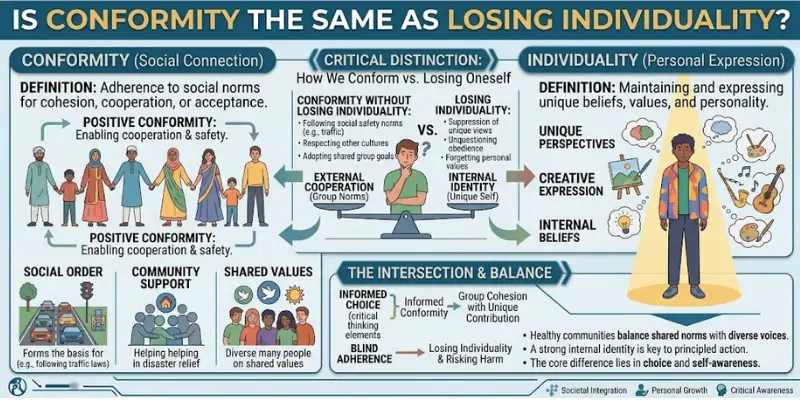
No. Conformity does not automatically mean that a person has lost individuality.
People regularly adjust their behavior to different social situations while maintaining personal values, preferences, and identities.
A person may follow workplace expectations during working hours, behave differently with family, and use another communication style with friends. Such adaptation does not necessarily represent unhealthy conformity.
The important distinction is whether the person can still make independent judgments and act according to their values when necessary.
Healthy social functioning involves both adaptation and individuality.
Frequently Asked Questions About Conformity in Social Psychology
What Is Conformity in Social Psychology in Simple Words?
Conformity in social psychology is the process of changing one’s behavior, opinions, judgments, or attitudes to become more consistent with other people or with the expectations of a group.
What Is a Simple Example of Conformity?
A simple example is a student changing an answer because most classmates selected a different answer. The student may believe the group is correct or may simply feel uncomfortable disagreeing with everyone else.
What Are the Two Main Types of Social Influence Behind Conformity?
The two commonly discussed forms are normative social influence and informational social influence. Normative influence involves fitting in and gaining acceptance, while informational influence involves looking to others for accurate information.
What Did the Asch Conformity Experiment Show?
The Asch experiments demonstrated that group pressure can influence individual judgments, even when the correct answer is relatively clear. The research became a classic demonstration of conformity in social psychology.
Is Conformity Good or Bad?
Conformity can be either helpful or harmful. It can support cooperation, learning, and social coordination, but excessive conformity can discourage independent thinking or contribute to harmful group behavior.
How Is Conformity Different From Obedience?
Conformity generally involves adjusting to group behavior or norms, while obedience involves responding to a direct command or instruction from an authority figure.
How Is Conformity Different From Compliance?
Compliance generally involves changing behavior in response to a request or demand. Conformity is broader and involves alignment with other people or group standards.
Can Children Experience Conformity?
Yes. Children may conform to classroom routines, friendship-group expectations, games, styles, opinions, and other social norms. Conformity is one part of children’s broader social experiences.
Can Conformity Happen Online?
Yes. Social media can create strong social signals through popularity, comments, likes, shares, trends, and group opinions. People may adjust their behavior or expressed opinions in response.
How Can Parents Help Children Handle Conformity?
Parents can teach children to recognize social pressure, consider consequences, express disagreement respectfully, establish boundaries, seek help when necessary, and distinguish positive group influence from harmful pressure.
Conclusion
Conformity in social psychology explains how people adjust their behavior, judgments, attitudes, or opinions to become more consistent with other people or with social-group expectations. It is a normal part of human social behavior and can occur in families, friendships, classrooms, workplaces, communities, and online environments.
People may conform because they want acceptance, because they fear rejection, because they are uncertain, or because they believe other people possess useful information. Normative social influence and informational social influence provide two important explanations for why conformity occurs.
The Asch conformity experiments demonstrated that group pressure can influence individual judgments even when the correct answer appears obvious. Later discussions of conformity have helped psychologists understand the roles of group size, unanimity, uncertainty, social relationships, public responses, and cultural context.
Conformity is not automatically harmful. It can support cooperation, learning, social coordination, and positive behavior. Problems arise when people stop evaluating group expectations independently or feel pressured into harmful behavior.
Understanding What Is Conformity in Social Psychology therefore requires looking beyond the simple idea of “following the crowd.” Conformity is a complex form of social influence that can help people function within groups while also creating situations in which independent thinking becomes especially important.
Please Write Your Comments