Personality: Definition, Types, Traits & Development – A Complete Guide
Updated: 17/02/2026
56
Personality is the unique combination of thoughts, emotions, behaviors, and attitudes that shape how an individual responds to the world. It influences how we communicate, make decisions, manage stress, build relationships, and achieve goals. From childhood through adulthood, personality continues to evolve under the influence of genetics, environment, culture, education, and life experiences.
In psychology, personality is considered a relatively stable yet adaptable pattern of behavior and mental processes. Understanding personality helps individuals improve self-awareness, emotional intelligence, career choices, leadership abilities, and overall mental well-being.
What is Personality?
Personality is the unique and consistent pattern of thoughts, emotions, behaviors, and attitudes that define how an individual interacts with others and responds to different situations in life. It makes each person distinct and influences communication style, decision-making, relationships, and overall behavior.
Definition of Personality
Personality is the combination of characteristics, traits, and behavioral patterns that shape a person’s way of thinking, feeling, and acting across various life situations.
Scientific Definition of Personality
In psychology, personality is defined as “the dynamic organization of psychophysical systems within an individual that determine characteristic patterns of behavior, thought, and emotion.”
This scientific definition emphasizes that personality is both biological and psychological, relatively stable, yet capable of change through experience and development.
Definitions of personality by famous psychologists
Below are the various definitions
1. Definition of Personality by Gordon Allport
“Personality is the dynamic organization within the individual of those psychophysical systems that determine his characteristic behavior and thought.”
Explanation:
Allport emphasized that personality is dynamic (changeable) and includes both mental and physical systems that shape behavior and thinking.
2. Definition of Personality by Sigmund Freud
“Personality is the result of the interaction between the id, ego, and superego.”
Explanation:
Freud believed personality is largely shaped by unconscious motives and early childhood experiences, governed by three mental structures:
- Id (instincts)
- Ego (reality)
- Superego (morality)
3. Definition of Personality by Carl Rogers
“Personality is the organized, consistent pattern of perceptions of the self that guides an individual’s behavior.”
Explanation:
Carl Rogers focused on self-concept, personal growth, and self-actualization, viewing personality as centered on how individuals see themselves and strive to improve.
4. Definition of Personality by Carl Jung
“Personality is the expression of the total psyche, including both conscious and unconscious aspects, shaped by universal archetypes.”
Explanation:
Jung believed personality is influenced by the collective unconscious, archetypes, and attitudes such as introversion and extraversion.
5. Definition of Personality by Alfred Adler
“Personality is shaped by an individual’s striving for superiority and the style of life developed in early childhood.”
Explanation:
Adler emphasized social interest, goal-oriented behavior, and how people compensate for feelings of inferiority.
6. Definition of Personality by Hans Eysenck
“Personality is a more or less stable and enduring organization of a person’s character, temperament, intellect, and physique that determines his unique adjustment to the environment.”
Explanation:
Eysenck focused on biological and genetic factors, proposing major personality dimensions such as:
- Extraversion
- Neuroticism
- Psychoticism
Comparison Table of Personality Theorists
| Psychologist | View of Personality | Key Concepts | Main Focus | Nature of Personality |
|---|---|---|---|---|
| Gordon Allport | Personality is a dynamic organization of psychophysical systems | Traits, individuality | Conscious behavior & traits | Dynamic and unique |
| Sigmund Freud | Personality develops from unconscious conflicts | Id, Ego, Superego | Unconscious mind & childhood | Largely unconscious |
| Carl Jung | Personality is shaped by conscious and unconscious forces | Collective unconscious, archetypes, introvert/extrovert | Balance of psyche | Symbolic and universal |
| Alfred Adler | Personality is goal-oriented and socially driven | Inferiority complex, striving for superiority, social interest | Social motivation & goals | Purposeful and social |
| Hans Eysenck | Personality has a biological and genetic basis | Extraversion, Neuroticism, Psychoticism | Biological traits | Stable and measurable |
Quick Exam Tip
- Allport → Traits
- Freud → Unconscious
- Jung → Archetypes
- Adler → Goals & Social Interest
- Eysenck → Biology & Dimensions
Importance of Personality in Daily Life
Personality plays a critical role in almost every aspect of life:
- Personal relationships: Affects communication style, empathy, and conflict resolution
- Career success: Influences leadership, teamwork, and job performance
- Mental health: Impacts stress management, resilience, and coping skills
- Decision-making: Shapes risk-taking, confidence, and judgment
- Social behavior: Determines adaptability, cooperation, and assertiveness
A well-developed personality improves self-confidence, emotional balance, and social harmony.
Key Components of Personality
Personality is built from several interconnected components:
1. Personality Traits
Traits are consistent characteristics such as honesty, confidence, optimism, or aggressiveness.
2. Temperament
Temperament refers to inborn emotional tendencies, such as calmness or irritability.
3. Character
Character reflects moral values, ethics, and integrity shaped by upbringing and culture.
4. Attitudes and Beliefs
These influence how individuals perceive people, situations, and challenges.
5. Behavior Patterns
Habitual responses to stress, authority, relationships, and responsibilities.
Major Personality Theories
Psychologists have developed several theories to explain personality development and structure.
Trait Theory
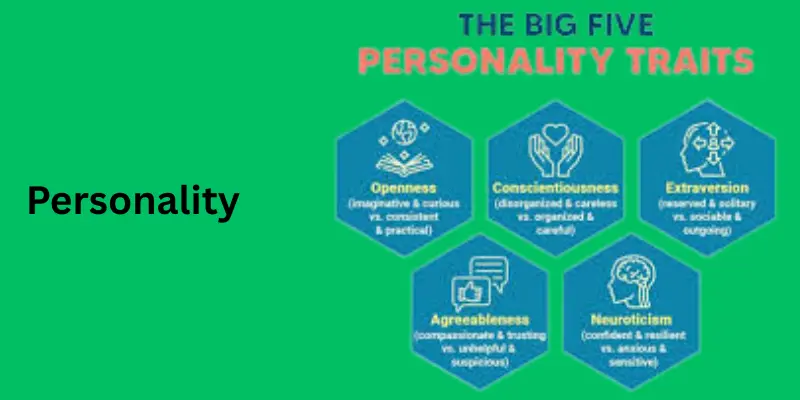
Trait theory focuses on identifying and measuring personality traits. The most accepted model is the Big Five Personality Traits.
Big Five Personality Traits (OCEAN)
| Trait | Description |
|---|---|
| Openness | Creativity, curiosity, imagination |
| Conscientiousness | Discipline, organization, responsibility |
| Extraversion | Sociability, energy, assertiveness |
| Agreeableness | Kindness, empathy, cooperation |
| Neuroticism | Emotional instability, anxiety |
Psychoanalytic Theory (Sigmund Freud)
Freud proposed that personality consists of three parts:
- Id: Primitive desires
- Ego: Rational decision-maker
- Superego: Moral conscience
This theory emphasizes unconscious influences on personality.
Behavioral Theory
Behaviorists believe personality is shaped by learning, conditioning, and environmental interactions rather than internal traits.
Humanistic Theory
Humanistic psychologists like Carl Rogers and Abraham Maslow emphasize free will, self-growth, and self-actualization.
Types of Personality
Personality types help categorize behavioral tendencies.
Introvert Personality
- Enjoys solitude
- Reflective and thoughtful
- Prefers deep conversations
Extrovert Personality
- Social and outgoing
- Energetic in group settings
- Expressive and assertive
Ambivert Personality
- Balanced mix of introversion and extroversion
- Adaptable in social situations
Personality Development
Personality development is a lifelong process influenced by multiple factors.
Factors Affecting Personality Development
- Genetics: Inherited traits
- Environment: Family, culture, education
- Social interactions: Friends, peers, mentors
- Life experiences: Success, failure, trauma
- Media and technology: Information exposure
How Personality Develops Over Life Stages
Childhood
- Foundation of temperament
- Influenced by parenting style
Adolescence
- Identity formation
- Social comparison and self-expression
Adulthood
- Stability with gradual refinement
- Career and relationship impact
Personality and Mental Health
Personality traits are closely linked to mental health outcomes. For example:
- High neuroticism may increase anxiety risk
- High conscientiousness supports self-discipline
- Agreeableness promotes emotional well-being
Balanced personality traits help maintain emotional stability and resilience.
Can Personality Change?
Yes, personality can change gradually through:
- Self-awareness
- Therapy or counseling
- Education and learning
- Mindfulness practices
- Positive habits and lifestyle changes
While core traits remain stable, behaviors and attitudes are adaptable.
Benefits of Understanding Personality
- Improved self-awareness
- Better career decisions
- Stronger relationships
- Enhanced emotional intelligence
- Effective leadership skills
Pros and Cons of Personality Awareness
| Pros | Cons |
| Self-improvement | Over-labeling |
| Better communication | Fixed mindset risk |
| Career alignment | Misinterpretation |
| Emotional control | Stereotyping |
Common Myths About Personality
- Personality never changes
- Introverts are shy
- Extroverts are better leaders
- Personality tests are always accurate
FAQs About Personality
1. What is personality in simple words?
Personality is the way a person thinks, feels, and behaves in everyday situations.
2. Is personality inherited or learned?
Personality is influenced by both genetics and environment, including upbringing and experiences.
3. Can personality change with age?
Yes, personality can evolve over time due to life experiences and personal growth.
4. What are the main personality traits?
The main traits are openness, conscientiousness, extraversion, agreeableness, and neuroticism.
5. Why is personality important in career success?
Personality affects communication, leadership, teamwork, and decision-making abilities.
6. How can I improve my personality?
Through self-awareness, learning, emotional intelligence, positive habits, and confidence-building activities.
Summary on Personality
Personality is the unique combination of thoughts, emotions, behaviors, and attitudes that define an individual and guide how they interact with the world. It is shaped by a mix of genetic, environmental, social, and psychological factors, and develops over a lifetime through experiences, learning, and self-reflection.
Famous psychologists have offered different perspectives on personality:
- Allport emphasized traits and individuality,
- Freud focused on unconscious conflicts,
- Jung highlighted archetypes and the collective unconscious,
- Adler stressed goals and social interest,
- Eysenck considered biological dimensions and stability.
Understanding personality helps in self-awareness, emotional intelligence, mental well-being, career growth, and relationship building. While core traits tend to be stable, behavior and attitudes are adaptable, making personality a dynamic aspect of human life that can be nurtured and developed continuously.
In short, personality is both a reflection of who we are and a tool for who we can become.
Conclusion
Personality is the foundation of human behavior and individuality. It shapes how we interact with others, handle challenges, and pursue success. By understanding personality traits, types, and development, individuals can enhance self-growth, mental well-being, and professional effectiveness. Personality is not fixed, it is a powerful, evolving aspect of who we are, capable of continuous improvement throughout life.
Please Write Your Comments