Piaget’s Stages of Cognitive Development: A Guide for Parents, Students & Educators
Updated: 11/02/2026
66
Piaget’s stages of cognitive development remain one of the most influential theories in developmental psychology. His framework explains how children think, learn, problem-solve, and interpret the world across childhood and adolescence. In today’s educational landscape—whether discussing child learning, personalized instruction, or homeschooling—Piaget’s insights still influence how educators structure learning experiences.
What makes Piaget important is not just the ages and stages. It’s the claim that children are active learners, continuously building mental representations through interaction, exploration, and reflection. This makes him a founding voice of constructivist learning theory, a perspective widely used in schools and psychology today.
Who Was Jean Piaget?
Jean Piaget (1896–1980) was a Swiss psychologist, biologist, and epistemologist. He wasn’t originally a child psychologist; rather, he became fascinated with how children answer questions differently than adults, revealing developmental patterns in reasoning. His research led him to conclude that children do not just know less — they think differently, and their thinking evolves in predictable stages.
His work bridged biology, cognition, education, and philosophy, influencing:
- developmental psychology
- pedagogy and teaching methods
- constructivism theory
- cognitive neurosciences
Piaget’s 4 Stages of Cognitive Development (With Age Ranges)
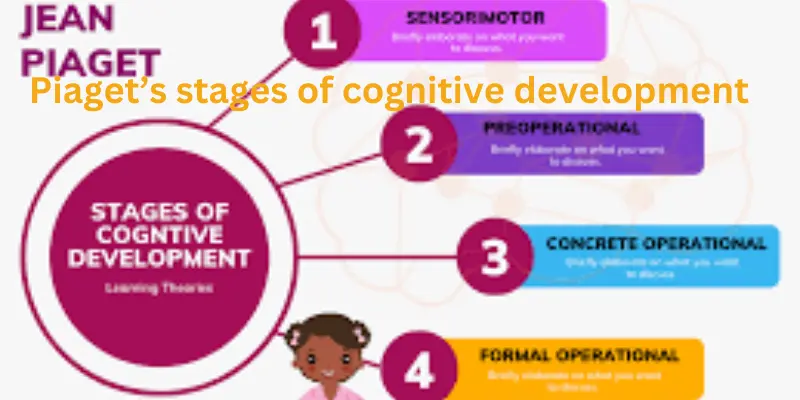
Piaget’s theory identifies four major stages:
| Stage | Approx. Age Range |
|---|---|
| Sensorimotor | Birth to 2 years |
| Preoperational | 2 to 7 years |
| Concrete Operational | 7 to 11 years |
| Formal Operational | 11 to adulthood |
These ages are approximate; Piaget believed developmental readiness varies, and modern developmental science often supports flexible age boundaries.
STAGE 1: SENSORIMOTOR (Birth to Age 2)
Core Concept
In the sensorimotor stage, infants learn about the world through senses, movement, and immediate interactions. Thinking is rooted in action rather than internal mental symbols.
Key Milestones
- responding to sensory stimuli
- grasping and sucking behaviors
- trial-and-error learning
- understanding cause-and-effect
- developing object permanence
- first symbolic thoughts (late stage)
Object Permanence & Why It Matters
Object permanence (the understanding that things still exist even when out of sight) is a defining achievement of this stage. Before it develops, a hidden toy simply “ceases to exist” for the infant. After object permanence emerges, curiosity and intentional search behaviors begin, signaling more advanced cognition.
Educational & Parenting Implications
During sensorimotor development, play is not just entertainment—it is the medium through which learning unfolds. Activities involving:
- peek-a-boo
- stacking blocks
- cause-and-effect toys
- crawling exploration
support early cognitive growth.
STAGE 2: PREOPERATIONAL (Ages 2 to 7)
Core Concept
Preoperational children begin using mental symbols, imagination, and language, yet still think intuitively rather than logically. They struggle with abstract reasoning and perspective-taking.
Defining Characteristics
- explosive language development
- imaginative play & symbolic thinking
- egocentrism (difficulty seeing others’ viewpoints)
- centration (focusing on one aspect at a time)
- animistic thinking (believing objects have feelings)
Egocentrism Example
A child might nod “yes” on the phone without realizing the listener cannot see them—an example of perspective limitation rather than selfishness.
Conservation Tasks
Piaget’s famous “conservation” experiments demonstrated that children in this stage struggle with the idea that quantity remains the same even when appearance changes (e.g., volume of water in different shaped glasses).
Educational Significance
Pretend play, storytelling, drawing, and verbal expression are essential. Teachers and parents are encouraged to:
- allow self-expression
- scaffold language
- encourage imaginative problem-solving
- avoid abstract explanations too early
STAGE 3: CONCRETE OPERATIONAL (Ages 7 to 11)
Core Concept
Children gain the ability to think logically about concrete, tangible information, though still struggle with hypothetical or abstract concepts.
Key Milestones
- conservation mastered
- decentration
- reversibility
- classification & categorization
- seriation
- inductive reasoning
Logical Thought in Action
Concrete operational children can understand:
- why 2+3=5
- how physical categories relate
- cause-and-effect sequences
But may struggle with questions like, “What if gravity stopped working?” which requires hypothetical thinking.
Education & Curriculum Implications
This stage aligns closely with elementary school instruction, where students are encouraged to:
- sort objects
- solve math problems
- conduct simple science experiments
Teachers often use hands-on learning, visual tools, and manipulatives to bridge abstract ideas to concrete experience.
STAGE 4: FORMAL OPERATIONAL (Age 11 to Adulthood)
Core Concept
Formal operational thinkers can handle abstract concepts, hypothetical reasoning, and systematic logic—skills essential for advanced mathematics, philosophy, and scientific inquiry.
Advanced Cognitive Skills
- deductive reasoning
- abstract thought
- hypothetical scenarios
- strategizing and planning
- metacognition (thinking about thinking)
Real-World Significance
Teenagers in this stage can ponder ethics, politics, emotions, identity, and future possibilities. As metacognition develops, academic self-regulation and personal philosophy become possible.
PIAGET’S THEORY AND MODERN CRITICISM
Although foundational, Piaget’s theory is not without critiques:
Common Criticisms
- Age underestimation: Many children demonstrate abilities earlier than Piaget predicted.
- Cultural variability: Development may vary across societies and learning environments.
- Learning influence: Piaget emphasized maturation; modern science emphasizes environment more strongly.
- Continuity vs stages: Some psychologists argue development may be continuous rather than stage-like.
PIAGET vs VYGOTSKY (Brief Comparison)
A popular comparison in developmental psychology contrasts Piaget with Lev Vygotsky:
| Feature | Piaget | Vygotsky |
|---|---|---|
| Focus | Individual exploration | Social & cultural context |
| Learning Driver | Self-discovery | Guidance + social interaction |
| Key Concept | Constructivism | Zone of Proximal Development |
| Language Role | Byproduct of cognition | Tool for cognition |
| Stages | Universal stages | No fixed stages |
Both perspectives are widely used in education today.
PIAGET & EDUCATION (Constructivism in Practice)
Piaget’s influence on modern education is massive, especially through constructivism, which argues that learners actively construct knowledge rather than passively absorb facts.
In Classroom Application
- discovery learning
- hands-on activities
- student-centered instruction
- problem-solving exploration
Educators tailor lessons to developmental readiness, avoiding abstract overload before a child is prepared for it.
WHY PIAGET STILL MATTERS TODAY
Even with criticism, Piaget remains essential because he introduced questions still central to developmental psychology:
- How do children think vs adults?
- What drives learning?
- How does reasoning progress?
- What makes learning meaningful?
Pros & Cons of Piaget’s Stages of Cognitive Development
| Pros (Strengths & Contributions) | Cons (Limitations & Criticisms) |
|---|---|
| Provides a structured, stage-based framework for cognitive development | Age ranges often vary; development isn’t always strictly stage-like |
| Highlights the importance of active learning and exploration | Underestimates children’s abilities—many acquire skills earlier |
| Influenced modern education, curriculum design, and child-centered pedagogy | Limited consideration of cultural, social, and environmental factors |
| Introduced key concepts (object permanence, conservation, egocentrism, etc.) | Overemphasizes biology and maturation over teaching and learning |
| Helped differentiate child development from adult cognition | Research based on small, homogenous samples |
| Widely used across psychology, education, and parenting domains | Lacks clarity on how transitions between stages occur |
| Encourages discovery learning and constructivism | Less applicable to individual differences and neurodiversity |
| Fits well with modern student-centered and hands-on instruction | Less flexible with overlap—real development often blends stages |
FAQs
Q1: What are Piaget’s four stages of cognitive development?
Sensorimotor, preoperational, concrete operational, and formal operational stages.
Q2: Why is Piaget’s theory important in education?
It helps teachers match instruction to developmental readiness and promotes active, hands-on learning.
Q3: What age is the formal operational stage?
Around age 11 through adulthood.
Q4: What is an example of the preoperational stage?
Pretend play, symbolic drawing, and egocentric speech are common examples.
Q5: How did Piaget study cognitive development?
Through observation, questioning, and tasks involving reasoning, logic, and conservation concepts.
Q6: Is Piaget’s theory still relevant today?
Yes, especially in developmental psychology, early childhood education, and constructivist teaching models.
Summary on Piaget’s Stages of Cognitive Development
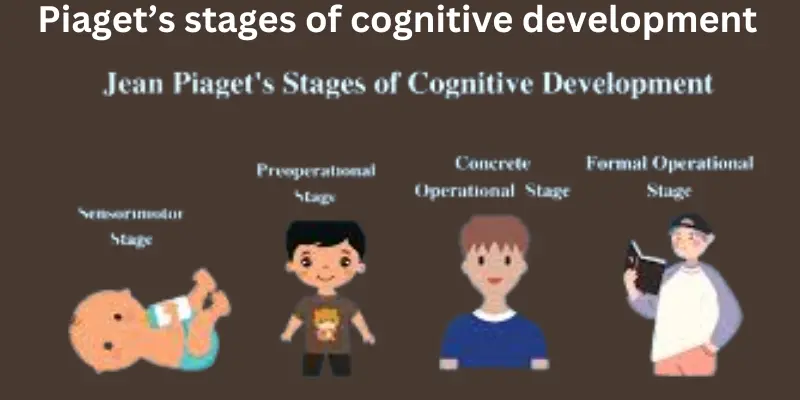
Piaget’s stages of cognitive development describe how children’s thinking and reasoning evolve from infancy to adulthood. According to Jean Piaget, cognitive growth happens through four universal stages: sensorimotor (0–2 years), preoperational (2–7 years), concrete operational (7–11 years), and formal operational (11+ years). Each stage reflects new mental abilities, from basic sensory exploration to symbolic thought, logical reasoning, and abstract problem-solving.
Piaget emphasized that children are active learners who build knowledge through exploration and interaction with the environment. His theory remains influential in psychology and education because it explains why children think differently at different ages, and why teaching should match developmental readiness. Even though later research shows variation in ages and cultural influences, Piaget’s framework continues to shape modern approaches to learning, curriculum design, and child development studies.
CONCLUSION
Piaget’s stages of cognitive development remain one of the strongest frameworks for understanding how children learn, reason, and grow intellectually. While modern research offers refinements, Piaget’s legacy continues to influence psychology, education, and parenting. Understanding these stages helps parents, teachers, and students better support childhood learning and cognitive readiness across development.
Please Write Your Comments