Child Development: Stages, Milestones, Theories & Modern Parenting Insights
Updated: 22/01/2026
133
Child development refers to the systematic biological, psychological, emotional, cognitive, and social changes that occur from infancy through adolescence. While human growth focuses on physical size, child development explains how children learn, behave, think, communicate, and express emotions. Modern research emphasizes that development is both sequential and interdependent, meaning progress in one area influences another.

Globally, child development sits at the intersection of developmental psychology, education, neuroscience, public health, and social sciences. International child development research now highlights the role of early childhood experiences in shaping lifelong learning, mental health, and social competence.
Governments, NGOs, healthcare institutions, and parents increasingly recognize that understanding development is not only beneficial for academic success but also for future well-being, career adaptability, emotional intelligence, and global citizenship.
What is Child Development?
Child development refers to the physical, cognitive, emotional, social, and behavioral changes that occur in children from birth through adolescence. It explains how children learn, think, communicate, interact, and become independent individuals. Child development is influenced by genetics (nature) and by environment, parenting, education, and culture (nurture).
Why Child Development Matters
Child development matters because foundational capabilities—language, memory, reasoning, decision-making, emotional regulation, and social awareness—are built progressively from birth. Neuroscientists estimate that 90% of brain architecture develops before age five, making early experiences critical for later outcomes.
Countries investing in early childhood development see benefits such as higher literacy rates, lower dropout rates, improved public health, reduced crime rates, and stronger economic productivity. Therefore, child development is both a personal and societal priority. UNICEF, WHO, and UNESCO repeatedly emphasize that early development investment produces some of the highest long-term returns globally.
For parents and caregivers, understanding development improves parenting strategies, reduces frustration, supports bonding, and provides clarity during milestone transitions.
Domains of Child Development
Researchers categorize child development into five primary domains. Each domain develops uniquely but remains interconnected.
1. Physical Development
Physical development includes biological growth, motor skills, coordination, and sensory abilities. It covers gross motor skills (running, jumping, balance) and fine motor skills (writing, holding objects, tying shoelaces). Nutrition, sleep, genetic factors, and physical activity directly influence this domain.
2. Cognitive Development
Cognitive development covers learning, problem-solving, memory, perception, logic, and reasoning. Influenced heavily by Piaget and modern neuroscience, cognitive development offers insight into how children make sense of the world. Stimulating environments, reading culture, and play-based learning enhance cognitive outcomes.
3. Language & Communication Development
This domain involves speech, vocabulary, grammatical understanding, narrative skills, and nonverbal communication. Research suggests that children spoken to more frequently show larger vocabularies and stronger academic performance. Multilingual environments can strengthen cognitive flexibility and global social adaptation.
4. Social & Emotional Development
Social-emotional development focuses on empathy, relationships, cooperation, confidence, emotional regulation, self-awareness, and moral understanding. Erikson’s developmental stages highlight how social interactions shape identity formation. Healthy emotional development supports resilience, mental health, and conflict resolution skills.
5. Adaptive & Behavioral Development
Adaptive development includes independence, decision-making, daily functional skills, self-care, and responsibility. Behavioral development examines self-control, discipline, and coping strategies—critical components for school and social integration.
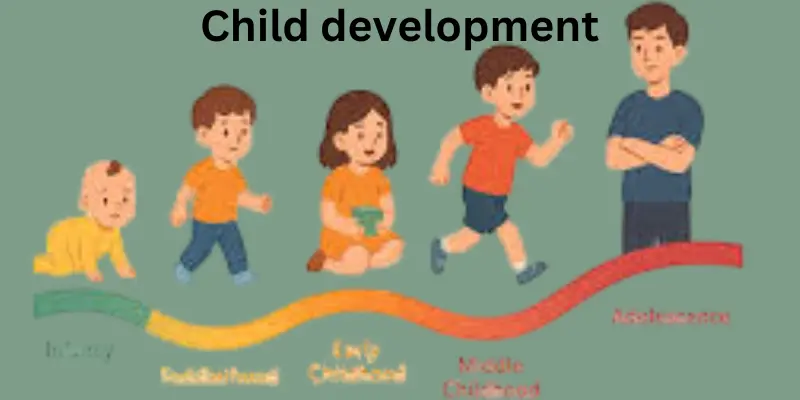
Child Development Stages (Birth to Adolescence)
Child development progresses in stages aligned with biological maturation and learning capabilities. While timelines vary globally, universal patterns exist.
Common global stages:
- Prenatal development (conception to birth)
- Infancy (0–2 years)
- Early childhood (2–6 years)
- Middle childhood (6–12 years)
- Adolescence (12–18+ years)
Each stage introduces new milestones, challenges, and opportunities for growth.
Major Theories of Child Development (Psychological Foundations)
Modern understanding is rooted in influential theorists:
Piaget’s Cognitive Stages
- Sensorimotor (0–2)
- Preoperational (2–7)
- Concrete operational (7–11)
- Formal operational (11+)
Erikson’s Psychosocial Stages
Focus on identity, autonomy, relationships, and competence across eight stages.
Vygotsky’s Sociocultural Theory
Emphasizes scaffolding, guided learning, and cultural influences.
Attachment Theory (Bowlby & Ainsworth)
Explores emotional bonds and security patterns.
Behaviorism (Skinner & Watson)
Highlights reinforcement, learning through environment, and conditioning.
Modern Neuroscience
Links brain architecture, neuroplasticity, and learning capacity.
These theories provide frameworks for educators, psychologists, and parents to support development strategically rather than reactively.
Milestones in Child Development
Milestones represent typical skills children acquire at specific ages. They guide early detection of delays and support planning in educational or clinical settings.
Infancy (0–2 years)
Key milestones include object permanence, attachment formation, imitation, babbling, and sensory exploration. Infants rely heavily on caregivers for emotional regulation and learning.
Early Childhood (2–6 years)
Children develop symbolic thinking, vocabulary expansion, pretend play, basic reasoning, emotional independence, and emerging empathy. Executive functioning begins forming here.
Middle Childhood (6–12 years)
Critical period for academic growth, moral reasoning, literacy, numeracy, teamwork, and structured learning. Peer influence increases as children refine identity and competence.
Adolescence (12–18+ years)
Adolescents seek autonomy, identity exploration, self-esteem, moral judgment, and long-term planning. Emotional turbulence reflects neurological pruning and hormonal shifts, not rebellion alone.
Factors Influencing Child Development (Nature + Nurture)
Development results from a dynamic interaction between biological predispositions and environmental inputs.
Key influences include:
- Genetics
- Prenatal environment
- Nutrition
- Parenting style
- Social environment
- Education system
- Culture & language exposure
- Socioeconomic status
- Technology & media exposure
Child Development Pros & Cons
| Pros (Advantages) | Cons (Challenges / Risks) |
|---|---|
| Encourages learning and curiosity | Developmental delays may appear |
| Builds emotional intelligence | Unequal access to education/resources |
| Strengthens language and communication skills | Poor parenting may affect outcomes |
| Improves social skills & confidence | Overexposure to technology can hinder development |
| Enhances problem-solving & reasoning | Stress or trauma negatively influence development |
| Supports independence and identity formation | Cultural pressure may affect self-esteem |
| Better future academic performance | Behavioral issues may arise without guidance |
| Prepares for adolescence & adulthood | Not all children develop at the same pace |
Child Development & Parenting (Modern Strategies)
Modern parenting emphasizes positive reinforcement, guided discipline, emotional validation, open communication, and structured autonomy. Research discourages purely authoritarian approaches and highlights responsive parenting for better cognitive and socio-emotional outcomes.
Parents also benefit from reading cues rather than forcing rigid expectations, recognizing each child’s developmental tempo.
Developmental Delays & Early Intervention
Delays in language, cognition, or social-emotional functioning are not uncommon globally. Early screening and intervention significantly improve outcomes. Pediatricians, psychologists, occupational therapists, and speech-language pathologists work collaboratively to support delays.
Holistic Development & Education
Schools worldwide are shifting from traditional academic models to holistic learning, integrating:
- creativity
- problem-solving
- emotional intelligence
- digital literacy
- global citizenship
This aligns education with future workforce demands in a rapidly transforming world.
FAQs
- What is child development in simple words?
Child development refers to how children grow, think, learn, communicate, and behave from birth through adolescence. It includes physical, cognitive, emotional, and social changes. - What are the stages of child development?
Common stages include infancy, early childhood, middle childhood, and adolescence. Each stage has unique milestones and learning patterns. - Why is child development important?
It shapes future learning, emotional health, social skills, academic performance, and life opportunities. Early development influences brain growth and future success. - What affects child development the most?
Genetics, nutrition, parenting style, education, environment, culture, and socioeconomic factors all play significant roles in shaping development. - Can child development be improved?
Yes, through nurturing relationships, positive parenting, play-based learning, early education, physical activity, and emotional support. - What is the difference between growth and development?
Growth refers to physical changes in size and height, while development refers to learning, intelligence, emotional regulation, and behavior.
Summary
Child development is a complex but rewarding journey that shapes the future of individuals and societies. Understanding stages, milestones, and influencing factors allows parents, educators, and professionals to support children more effectively. With early experiences forming the foundation for lifelong learning, health, and well-being, investing in development is one of the strongest global priorities for the 21st century.
Conclusion
Child development is a continuous and interconnected process that shapes a child’s future learning, behavior, health, and social functioning. Understanding how children grow across different developmental domains allows parents, teachers, and caregivers to provide better support, resources, and guidance. While healthy development offers long-lasting benefits such as confidence, emotional regulation, stronger academic foundations, and improved social skills, challenges like developmental delays, social pressure, or unequal opportunities can create barriers.
Therefore, creating nurturing environments, responsive parenting, and access to quality education play an essential role in helping children reach their full potential as capable and responsible individuals.
Please Write Your Comments