Child Psychology Courses: A Guide for Students, Parents & Professionals
Updated: 14/12/2025
64
Introduction
Child Psychology Courses are among the most in-demand academic and professional study programs in psychology today. With increasing awareness of children’s mental health, emotional development, learning disorders, behavioral issues, and cognitive growth, thousands of students, teachers, and parents search for structured and accredited child development psychology courses, child counseling courses, and child behavior psychology programs every month, and What Is Psychology
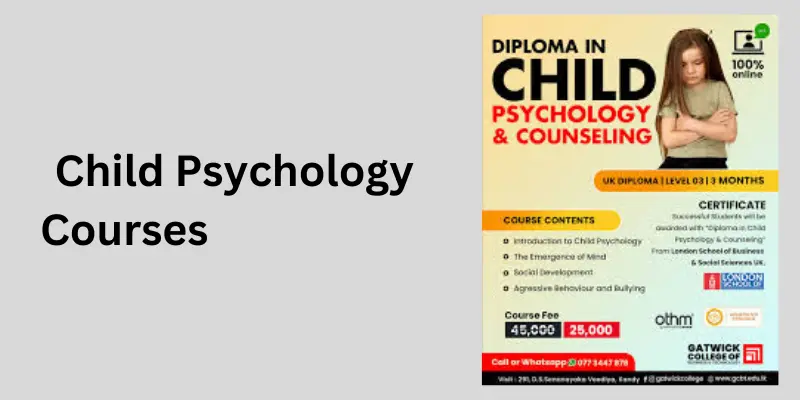
Whether someone wants to become a child psychologist, a child counselor, a school psychologist, a special education expert, or simply understand children’s behavior better, these courses offer essential learning pathways.
What Is Child Psychology?
Child psychology is a major branch of psychology focused on understanding children from birth to adolescence. It includes:
- Emotional development
- Cognitive development
- Learning patterns
- Behavioral issues
- Social interactions
- Mental health conditions
- Developmental disorders
Why Study Child Psychology Courses?
People enroll in these courses for various reasons. Some want a full-time career; others want to understand child development better.
Major Reasons to Study Child Psychology:
- To understand children’s emotions and behavior
- To help children with learning difficulties
- To manage behavioral problems positively
- To support mental health and well-being
- To build better parenting or teaching skills
- To become a certified child psychologist or counselor
- To enhance professional qualifications
Child Psychology vs Developmental Psychology (Comparison Table)
| Factor | Child Psychology | Developmental Psychology |
|---|---|---|
| Definition | A branch of psychology focused exclusively on the mental, emotional, social, and behavioral development of children (birth to adolescence). | A broader branch that studies human development across the entire lifespan—from infancy to old age. |
| Scope | Narrow scope; limited to childhood stages. | Wide scope; covers infancy, childhood, adolescence, adulthood, and elderly years. |
| Age Range | Birth to 12–18 years. | Birth to late adulthood (entire lifespan). |
| Primary Focus | Understanding children’s emotions, behavior, learning patterns, and mental health. | Understanding physical, cognitive, emotional, social, and moral development across all stages of life. |
| Key Topics | Child behavior, emotional regulation, learning disabilities, child counseling, personality development. | Lifespan growth, aging, cognitive changes, identity formation, developmental milestones. |
| Disorders Studied | ADHD, autism, learning disabilities, childhood anxiety, behavior disorders. | Age-related disorders like dementia, cognitive decline, identity issues, life transitions, plus childhood disorders. |
| Major Theories Applied | Piaget (cognitive development), Erikson’s childhood stages, Bowlby’s attachment theory, Vygotsky’s learning theory. | Erikson’s entire 8-stage theory, Kohlberg’s moral development, Baltes’ lifespan theory, Piaget’s and others. |
| Research Methods | Observational studies with children, play-based assessments, child cognitive testing. | Longitudinal studies, cross-sectional research, cognitive aging tests, lifespan behavior analysis. |
| Applications | Parenting, teaching, child therapy, child counseling, classroom management, pediatric psychology. | Education, aging research, family counseling, geriatric psychology, social development research. |
| Career Paths | Child Psychologist, Child Counselor, School Psychologist, Pediatric Behavioral Specialist. | Developmental Psychologist, Researcher, Aging Specialist, Academic Professor, Human Development Consultant. |
| Work Environments | Schools, child hospitals, pediatric clinics, NGOs, child development centers. | Colleges, research institutions, hospitals, rehabilitation centers, government agencies. |
| Main Goal | To improve children’s mental health, learning, and well-being. | To understand how humans grow and change across the lifespan. |
| Assessment Tools | IQ tests for children, behavioral assessments, learning disability tests, emotional development scales. | Lifespan scales, aging tests, cognitive function assessments, personality and identity measures. |
| Duration of Study | Focused training specific to child-related issues. | Broad academic training covering every developmental stage. |
| Professional Demand | High demand in schools, child clinics, and early development programs. | High demand in universities, research labs, government programs, and rehabilitation centers. |
| Similarity | Both study human development and use psychological theories to understand behavior. | Both overlap in childhood but developmental psychology continues beyond adolescence. |
| Difficulty Level | Moderate (specific age range). | Broad and more complex (entire lifespan). |
Types of Child Psychology Courses
Below are the most popular categories searched online.
1. Certificate Courses in Child Psychology
Short-term programs for beginners.
Duration: 1–6 months
Best For: Teachers, parents, social workers, beginners
Popular Keywords:
child psychology certificate course, child behaviour certification, children mental health course online
2. Diploma in Child Psychology
More in-depth learning with practical knowledge.
Duration: 6–12 months
Best For: Those seeking professional skills or entry-level child counseling roles.
3. Bachelor’s Degree in Child Psychology
Part of a BA/BSc in Psychology with specialization.
Duration: 3–4 years
Ideal For: Students starting their psychology career.
4. Master’s Degree in Child Psychology
Advanced professional course.
Duration: 2 years
Best For: Those wanting to become a licensed child psychologist or therapist.
5. Child Counseling Courses
Focused on child mental health, counseling techniques, and therapy.
Keywords:
child counseling skills, child therapy course, school counseling specialization
6. Developmental Psychology Courses
Covers complete human development from infancy to adolescence.
7. Special Education & Learning Disorder Courses
Focused on:
- ADHD
- Autism (ASD)
- Dyslexia
- Behavioral disorders
8. Online Child Psychology Courses
Flexible, self-paced programs offered by top universities and platforms.
PSYCHOLOGY MEGA TABLE (Branches • Fields • Types • Examples • Founders/Theorists)
| Category | Name | Definition / Focus Area | Examples / Real-World Applications | Founder / Key Theorist |
|---|---|---|---|---|
| Branch | Clinical Psychology | Study, diagnosis & treatment of mental disorders. | Therapy, mental health assessment, treatment plans. | Sigmund Freud, Carl Rogers, Aaron Beck |
| Branch | Child Psychology | Focuses on emotional, social & cognitive development of children. | ADHD assessment, child counseling, behavioral therapy. | Jean Piaget, Erik Erikson, John Bowlby |
| Branch | Developmental Psychology | Studies human growth across lifespan. | Lifespan assessments, aging studies, developmental milestones. | Jean Piaget, Erik Erikson |
| Branch | Educational Psychology | Studies how people learn and how education can be improved. | Teaching strategies, learning assessment, classroom management. | Edward Thorndike, Lev Vygotsky |
| Branch | Counseling Psychology | Helping individuals overcome emotional, social, and behavioral issues. | Relationship counseling, stress management, coping strategies. | Carl Rogers, Alfred Adler |
| Branch | Cognitive Psychology | Study of mental processes like memory, perception, problem-solving. | AI-human interface, memory training programs, decision-making research. | Ulric Neisser |
| Branch | Forensic Psychology | Application of psychology in law and criminal justice. | Criminal profiling, courtroom evaluations, eyewitness analysis. | Hugo Münsterberg |
| Branch | Health Psychology | How psychological factors affect health and illness. | Stress reduction programs, lifestyle change interventions. | Joseph Matarazzo |
| Branch | Social Psychology | How individuals behave in social contexts. | Group behavior research, persuasion studies, attitude change. | Kurt Lewin |
| Branch | Industrial-Organizational Psychology | Application of psychology in workplaces. | Employee motivation, HR assessments, organizational behavior programs. | Hugo Münsterberg, Frederick Taylor |
| Field | Neuropsychology | Relation between brain structures & psychological functions. | Brain injury rehabilitation, memory-improvement therapy. | Alexander Luria |
| Field | Abnormal Psychology | Study of abnormal behaviors, disorders, and treatments. | OCD treatment, trauma therapy, personality disorder research. | Emil Kraepelin |
| Field | Positive Psychology | Study of happiness, strengths, and well-being. | Resilience training, gratitude therapy, well-being workshops. | Martin Seligman |
| Field | Sports Psychology | Psychology applied to sports performance and motivation. | Athlete performance enhancement, team dynamics, mental training. | Coleman Griffith |
| Field | Environmental Psychology | How environment influences human behavior. | Architecture design psychology, noise impact research. | Harold Proshansky |
| Field | Rehabilitation Psychology | Helping individuals recover from physical, emotional, and cognitive disabilities. | Disability counseling, rehab therapy. | Lightner Witmer |
| Field | Consumer Psychology | How people make buying decisions. | Advertising psychology, brand loyalty studies. | Walter Dill Scott |
| Field | Comparative Psychology | Studies animal behavior to understand humans. | Animal intelligence tests, evolutionary behavior studies. | Charles Darwin |
| Type | Behavioral Psychology | Study of observable behavior and learning through conditioning. | Behavior modification, reinforcement programs. | B.F. Skinner, John Watson, Ivan Pavlov |
| Type | Humanistic Psychology | Emphasizes free will, self-actualization, and human potential. | Client-centered therapy, growth mindset training. | Carl Rogers, Abraham Maslow |
| Type | Biopsychology | Relationship between biology and behavior. | Brain scans, hormones & behavior research. | Donald Hebb |
| Type | Personality Psychology | Study of personality traits and patterns. | Personality assessments (MBTI, Big Five). | Gordon Allport |
| Type | Evolutionary Psychology | Studies how evolution shapes behavior. | Mate selection research, survival tendencies. | Charles Darwin (foundation), David Buss |
| Type | Cultural Psychology | Understanding how culture influences behavior. | Cross-cultural studies, global psychology research. | Lev Vygotsky |
| Type | Experimental Psychology | Conducting scientific experiments to study behavior. | Lab behavior studies, perception experiments. | Wilhelm Wundt |
| Type | Psychometrics | Psychological measurement & testing. | IQ tests, personality tests, aptitude assessments. | Francis Galton, Alfred Binet |
| Type | Military Psychology | Psychology applied to soldiers and defense systems. | Trauma counseling, combat stress therapy. | Walter Dill Scott |
| Applied Field | School Psychology | Supporting child learning & mental health in educational settings. | Child assessments, behavior modification, parent counseling. | Lightner Witmer |
| Applied Field | Geropsychology | Focus on elderly mental health. | Dementia research, aging therapy, memory support. | Bernice Neugarten |
| Applied Field | Pediatric Psychology | Mental health and illness in children. | Chronic illness coping programs, hospital-based therapy. | Logan Wright |
| Applied Field | Occupational Health Psychology | Improving worker well-being and job performance. | Stress reduction, burnout management. | E.K. Taylor, James Quick |
| Applied Field | Crisis Psychology | Handling psychological emergencies. | Disaster management therapy, crisis intervention. | Jeffrey T. Mitchell |
| Approach | Psychoanalytic Psychology | Behavior driven by unconscious motives. | Dream analysis, free association. | Sigmund Freud |
| Approach | Gestalt Psychology | Human perception as whole patterns. | Problem-solving therapy, design psychology. | Max Wertheimer |
| Approach | Structuralism | Breaking down mental processes into components. | Early experimental psychology. | Wilhelm Wundt |
| Approach | Functionalism | How the mind functions to adapt. | Behavior studies, applied psychology roots. | William James |
| Approach | Cognitive-Behavioral Psychology (CBT) | Thought patterns influence behavior. | Cognitive therapy for anxiety, depression. | Aaron Beck |
| Approach | Existential Psychology | Understanding meaning, identity, and free will. | Existential therapy, meaning-focused counseling. | Viktor Frankl |
| Specialized Field | Addiction Psychology | Understanding substance use & behavioral addictions. | Rehabilitation therapy, addiction counseling. | E.M. Jellinek |
| Specialized Field | Criminal Psychology | Study of criminal behavior & profiling. | Crime investigation, offender analysis. | Hans Gross |
| Specialized Field | Health Behavior Psychology | Impact of behavior on health. | Behavioral change models, disease prevention programs. | B.J. Fogg (modern) |
| Specialized Field | Learning Psychology | How learning happens and changes behavior. | Classroom techniques, reinforcement learning. | Skinner, Pavlov |
| Specialized Field | Language Psychology | Study of language development and processing. | Speech therapy, communication studies. | Noam Chomsky |
| Specialized Field | Motivation Psychology | Why people act the way they do. | Productivity programs, motivation training. | Abraham Maslow |
| Specialized Field | Perception Psychology | How humans interpret sensory information. | UX design, vision perception research. | Hermann von Helmholtz |
| Specialized Field | Emotion Psychology | Study of emotional processes. | Anger management therapy, emotional intelligence training. | James-Lange, Cannon-Bard |
Who Can Enroll in Child Psychology Courses?
You can enroll if you are:
- A student interested in psychology
- A teacher or school counselor
- A parent wanting better child handling skills
- A social worker or NGO worker
- A pediatric healthcare professional
- Anyone passionate about child development
Eligibility:
- Certificate: Open to all
- Diploma: Matric/Intermediate
- Bachelor’s: After 12th grade
- Master’s: Bachelor’s in psychology or related field
Skills You Learn in Child Psychology Courses
Students learn essential theoretical and practical skills, such as:
- Understanding child emotions
- Managing behavior problems
- Identifying learning disabilities
- Counseling techniques
- Psychological assessment
- Child development stages
- Communication skills
- Therapeutic approaches
- Classroom management
- Parenting guidance techniques
Course Curriculum & Syllabus
Most institutes follow a similar syllabus.
Core Subjects:
- Introduction to Child Psychology
- Stages of Child Development
- Cognitive & Emotional Development
- Behavioral Issues in Children
- Child Mental Health Disorders
- Learning Disabilities (ADHD, ASD, Dyslexia)
- Social & Moral Development
- Child Counseling Techniques
- Psychological Assessments
- Classroom Behavior Management
- Developmental Theories (Piaget, Freud, Erikson, Vygotsky)
- Child Protection & Safeguarding
Top Online Platforms Offering Child Psychology Courses
Coursera
Udemy
edX
FutureLearn
Alison
Harvard Online
Stanford Continuing Studies
Open University
Child Mental Health Institute Courses
These platforms offer beginner to advanced programs with certificates.
Top Universities Offering Child Psychology Programs
- Harvard University
- Stanford University
- University of Cambridge
- University of Oxford
- University of Toronto
- University of Melbourne
- University of London
- University of Edinburgh
- University of British Columbia
Duration & Fees of Child Psychology Courses
| Course Type | Duration | Fee Range |
|---|---|---|
| Certificate | 1–6 months | $20 – $200 |
| Diploma | 6–12 months | $200 – $1,000 |
| Bachelor’s | 3–4 years | $5,000 – $35,000/year |
| Master’s | 2 years | $10,000 – $40,000 |
| Online Courses | Self-paced | Free – $300 |
Career Opportunities After Child Psychology Courses
Popular Job Roles:
- Child Psychologist
- Child Counselor
- School Psychologist
- Special Education Teacher
- Behavioral Therapist
- Child Welfare Worker
- Educational Consultant
- Child Development Specialist
- Clinical Psychologist
- Pediatric Mental Health Worker
Salary Scope
Average salary depends on country, education, and experience.
General Salary Range:
- Entry-level: $25,000 – $40,000
- Mid-level: $45,000 – $70,000
- Experienced: $75,000 – $120,000+
Benefits of Studying Child Psychology
- Better understanding of child behaviour
- Ability to help children emotionally and mentally
- High-growth career opportunities
- Important for parenting and teaching
- Deep knowledge of child development
- Skills to support children with special needs
Frequently Asked Questions (FAQs)
1. What is the best child psychology course for beginners?
A certificate course in child psychology or child development is best for beginners because it provides foundational knowledge in simple terms.
2. How long does it take to complete a child psychology course?
A basic certificate takes 1–6 months, while degrees like BA/BSc take 3–4 years and Master’s programs take 2 years.
3. Can I study child psychology online?
Yes. Many accredited platforms like Coursera, edX, FutureLearn, and Udemy offer high-quality online child psychology courses with certificates.
4. What qualifications do I need to become a child psychologist?
You need a Bachelor’s degree in psychology, followed by a Master’s in Child Psychology or Clinical Psychology, and supervised training.
5. Are child psychology courses good for teachers?
Yes, especially for classroom behavior management, understanding learning disabilities, and improving communication with children.
6. What jobs can I get after completing child psychology courses?
You can work as a child counselor, behavioral therapist, special needs teacher, school psychologist, development specialist, or mental health assistant.
Summary
Child Psychology Courses are essential for anyone who wants to understand, support, and guide children in their emotional, behavioral, and cognitive development. These courses offer the perfect blend of theory and practical skills, helping learners explore children’s minds, manage behavioral issues, understand learning disorders, and support mental health. Whether you choose a certificate, diploma, bachelor’s, or master’s degree, child psychology opens doors to powerful career opportunities while empowering you to make a meaningful impact on children’s lives.
Conclusion
Child Psychology Courses provide deep knowledge about how children think, behave, grow, and learn. With rising awareness about children’s mental health and development, these courses have become essential for teachers, parents, psychologists, and social workers. From online certificate courses to advanced university degrees, there is an option for everyone. If your goal is to build a meaningful career, support children emotionally, or understand child behavior better, studying child psychology is one of the most rewarding choices you can make.
Please Write Your Comments