Types of Psychology: A Complete Expert Guide to All Branches, Fields, and Uses
Updated: 10/12/2025
133
Introduction
Psychology is one of the most diverse, evolving, and widely applied scientific disciplines in the world today. With growing interest in mental health, behavioral science, emotions, cognition, and human development, people frequently search for types of psychology, branches of psychology, fields of psychology, and areas ofpsychology to understand how each specialty works and what it deals with.
Psychology is the scientific study of the mind, behavior, emotions, personality, learning, perception, and human development. Over the years, psychology has expanded into a wide range of specializations, each focusing on a specific aspect of human behavior or mental processes.
This article provides a full, EEAT-optimized explanation of all major types and fields of psychology, their purpose, importance, examples, benefits, applications, and real-world uses. You will also learn about the difference between branches vs fields of psychology, career scopes, and the way psychology shapes mental well-being.
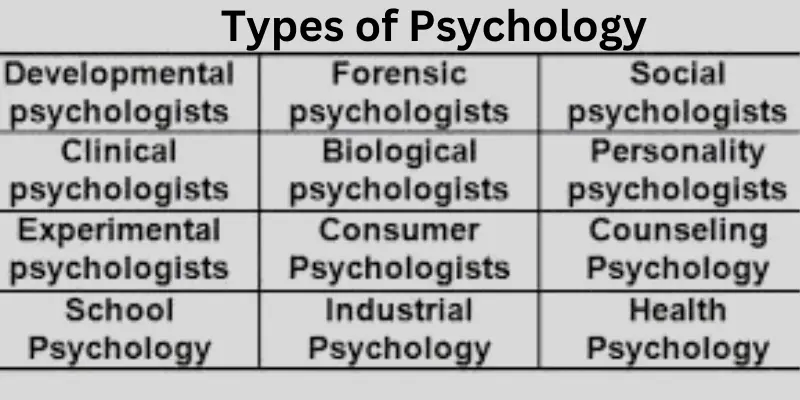
Major Types of Psychology (Comprehensive List)
Here is the complete, SEO-friendly list of all major and commonly searched types of psychology:
- Clinical Psychology
- Counseling Psychology
- Cognitive Psychology
- Behavioral Psychology
- Biological Psychology
- Developmental Psychology
- Social Psychology
- Industrial-Organizational Psychology
- Educational Psychology
- Forensic Psychology
- Health Psychology
- Sports Psychology
- Personality Psychology
- Positive Psychology
- Neuropsychology
- Experimental Psychology
- Comparative Psychology
- Evolutionary Psychology
- Abnormal Psychology
- Environmental Psychology
- Consumer Psychology
- Cross-Cultural Psychology
- Humanistic Psychology
- Rehabilitation Psychology
- Military Psychology
- Educational & School Psychology
- Cyberpsychology
- Community Psychology
Each field plays a different role and contributes to understanding behavior from various angles.
Detailed Explanation of Each Major Type of Psychology
Below is a complete breakdown of every psychology type with in-depth explanations.
1. Clinical Psychology
Clinical psychology focuses on diagnosing, treating, and managing mental health disorders such as:
- Depression
- Anxiety
- Bipolar disorder
- Schizophrenia
- Personality disorders
Clinical psychologists use psychotherapy, assessment tools, and treatment plans. It is the largest and most popular field of psychology.
2. Counseling Psychology
Counseling psychology helps individuals cope with:
- Stress
- Relationship issues
- Grief
- Career challenges
- Emotional struggles
It focuses more on life problems, not severe mental illness.
3. Cognitive Psychology
Cognitive psychology studies:
- Learning
- Memory
- Thinking
- Problem-solving
- Decision-making
- Perception
This field is the foundation of AI, machine learning, and educational systems.
4. Behavioral Psychology
Also called behaviorism, it studies observable behavior and how it is shaped by:
- Rewards
- Punishments
- Conditioning
- Habits
Behavior therapy and behavior modification techniques come from this branch.
5. Biological Psychology
Biological psychology explains how the brain, nervous system, hormones, and genetics affect human behavior.
It is closely related to:
- Neuroscience
- Neuropsychology
- Psychopharmacology
6. Developmental Psychology
Developmental psychology studies how people grow physically, emotionally, cognitively, and socially from infancy to old age.
It is widely used in:
- Parenting
- Child development
- School education
- Geriatric care
7. Social Psychology
This field examines how society influences our thoughts and actions.
Topics include:
- Group behavior
- Social identity
- Attitudes
- Prejudice
- Leadership
- Social influence
Social psychology helps understand behavior in crowds, workplaces, politics, and media.
8. Industrial-Organizational Psychology (I-O Psychology)
One of the fastest-growing applied psychology fields.
It focuses on:
- Employee performance
- Workplace motivation
- Hiring strategies
- Leadership development
- Productivity
- HR assessments
Companies use I-O psychology to increase efficiency and employee satisfaction.
9. Educational Psychology
This field helps improve learning processes through:
- Learning styles
- Memory
- Student motivation
- Teaching strategies
- Curriculum design
Teachers and educational institutions rely on this field heavily.
10. Forensic Psychology
Forensic psychology connects law and psychology.
Specialists work in:
- Criminal investigations
- Court testimony
- Prison systems
- Criminal profiling
- Victim assessment
It is widely used in modern legal systems.
11. Health Psychology
Health psychologists study how behavior affects physical health.
They help with:
- Stress management
- Chronic illness
- Healthy habits
- Lifestyle changes
Frequently used in hospitals and wellness programs.
12. Sports Psychology
Athletes use sports psychology to improve:
- Focus
- Motivation
- Confidence
- Stress management
Sports psychologists are part of professional athletic teams.
13. Personality Psychology
This branch studies:
- Personality traits
- Temperament
- Individual differences
It explains why people behave differently in similar situations.
14. Positive Psychology
Positive psychology focuses on:
- Happiness
- Strengths
- Well-being
- Life satisfaction
- Mindfulness
It promotes a healthy and optimistic mindset.
15. Neuropsychology
Neuropsychology studies how brain injuries, strokes, trauma, and neurological diseases affect behavior and thinking.
Used in:
- Hospitals
- Rehabilitation centers
- Brain assessments
16. Experimental Psychology
Involves scientific studies on behavior through experiments in labs and universities.
17. Comparative Psychology
Studies similarities and differences between human and animal behavior.
18. Evolutionary Psychology
Explains behavior through the lens of evolution, natural selection, and survival needs.
19. Abnormal Psychology
Focuses on:
- Abnormal behaviors
- Mental disorders
- Therapy methods
Forms the basis of clinical psychology.
20. Environmental Psychology
Studies how environments influence behavior:
- Noise
- Lighting
- Pollution
- Urban design
Useful in architecture and public health.
21. Consumer Psychology
Deals with buying behavior, advertising influence, and purchasing decisions.
Companies use it for better product marketing.
22. Cross-Cultural Psychology
Explores how culture shapes:
- Personality
- Beliefs
- Social behavior
Important in global research.
23. Humanistic Psychology
Centers on:
- Free will
- Personal growth
- Self-actualization
This field emphasizes empathy and personal values.
24. Rehabilitation Psychology
Helps people recover from:
- Physical injuries
- Disabilities
- Chronic conditions
25. Military Psychology
Used in:
- Soldier training
- Combat stress
- PTSD counseling
26. Cyberpsychology
A modern field covering:
- Internet behavior
- Social media influence
- Digital addiction
- Virtual reality psychology
27. Community Psychology
Focuses on community well-being, public health, and social problems.
Comparison Table: Branches vs Fields of Psychology
| Category | Branches of Psychology | Fields of Psychology |
|---|---|---|
| Definition | Academic or theoretical areas of psychology | Applied or professional areas |
| Focus | Concepts, theories, research | Practical application |
| Examples | Cognitive, Behavioral, Biological | Clinical, Forensic, I-O, Counseling |
| Purpose | Understand behavior | Solve real-world problems |
| Learning Level | Mostly taught in university courses | Used in hospitals, courts, schools |
How Types of Psychology Work
The different types of psychology work by:
- Studying human behavior through scientific research.
- Observing emotional, cognitive, and social patterns.
- Using theories to explain why people behave a certain way.
- Applying psychological methods to solve mental, social, and real-world problems.
- Creating assessments, therapy models, and behavior modification techniques.
- Integrating brain science, genetics, environment, and personal differences.
Through these mechanisms, psychology helps improve mental well-being, education, workplaces, relationships, and human performance.
Comparison Table: Types of Psychology
| Type of Psychology | Main Focus | Key Techniques/Methods | Where It’s Used | Who Needs It |
|---|---|---|---|---|
| Clinical Psychology | Mental disorders, emotional problems | Psychotherapy, assessments, CBT | Hospitals, clinics, mental health centers | People with depression, anxiety, PTSD |
| Counseling Psychology | Life issues, emotional well-being | Talk therapy, counseling sessions | Schools, colleges, counseling centers | Students, couples, families |
| Cognitive Psychology | Thinking, memory, learning | Experiments, cognitive tests | AI research, education | Students, researchers, AI developers |
| Behavioral Psychology | Behavior patterns, conditioning | Reinforcement, behavior modification | Therapy, education, rehabilitation | Individuals with behavioral issues |
| Biological Psychology | Brain, hormones, nervous system | Brain scans, neurological tests | Hospitals, research labs | Neurology patients, researchers |
| Developmental Psychology | Human growth from infancy to old age | Observations, developmental tests | Schools, child care, geriatric care | Children, parents, elderly individuals |
| Social Psychology | Social influence, group behavior | Surveys, experiments, observations | Marketing, politics, HR | Public organizations, companies |
| Industrial-Organizational Psychology | Workplace behavior, productivity | Personality tests, performance analysis | Companies, HR departments | Employers, job seekers |
| Educational Psychology | Learning processes, student behavior | Learning strategies, assessments | Schools, colleges, learning centers | Teachers, students |
| Forensic Psychology | Law + psychology, criminal behavior | Profiling, evaluations, court testimony | Courts, prisons, law enforcement | Criminal investigators, lawyers |
| Health Psychology | Lifestyle, stress, health behavior | Counseling, stress therapy | Hospitals, wellness programs | Patients with chronic illness |
| Sports Psychology | Athletic performance, motivation | Mental training, stress control | Sports teams, gyms | Athletes, sports coaches |
| Personality Psychology | Traits, temperament, identity | Personality tests (MBTI, Big 5) | Counseling, hiring, research | Students, HR, individuals |
| Positive Psychology | Happiness, well-being, strengths | Mindfulness, gratitude practices | Therapy, coaching, wellness | Anyone seeking life satisfaction |
| Neuropsychology | Brain injuries + behavior | Brain mapping, cognitive tests | Hospitals, neuro clinics | Stroke/TBI patients |
| Experimental Psychology | Research & scientific behavior studies | Controlled experiments | Universities, labs | Researchers, students |
| Comparative Psychology | Animal vs. human behavior | Observational studies | Animal behavior labs | Zoologists, researchers |
| Evolutionary Psychology | Human survival behavior | Evolution-based analysis | Research, anthropology | Scholars, students |
| Abnormal Psychology | Abnormal behavior, disorders | Diagnosis, therapy planning | Clinics, hospitals | Patients with mental illness |
| Environmental Psychology | Environment + behavior | Field studies | Urban planning, architecture | Designers, policymakers |
| Consumer Psychology | Buying behavior & marketing | Surveys, A/B testing | Advertising firms, retail | Marketers, businesses |
| Cross-Cultural Psychology | Behavior across cultures | Cultural comparisons | NGOs, global companies | International organizations |
| Humanistic Psychology | Self-growth, free will | Client-centered therapy | Therapy centers | Individuals seeking personal growth |
| Rehabilitation Psychology | Recovery after injury | Rehab counseling | Rehab centers, hospitals | Injured or disabled patients |
| Military Psychology | Combat stress, soldier mental health | Stress therapy, assessments | Military bases, VA hospitals | Soldiers, veterans |
| Cyberpsychology | Online behavior, digital addiction | Digital assessments | Social media labs, tech firms | Internet users, researchers |
| Community Psychology | Community well-being | Public health surveys | NGOs, government | Social workers, communities |
Benefits of Understanding Types of Psychology
Understanding the types of psychology helps:
1. Improve Mental Health
Know which psychologist to consult for specific issues.
2. Choose the Right Psychology Career
Students can select fields like clinical, forensic, counseling, or neuropsychology.
3. Improve Relationships
Social and counseling psychology enhance communication.
4. Boost Productivity
I-O psychology improves workplace motivation.
5. Enhance Learning
Educational psychology supports better teaching and learning.
6. Understand Human Behavior
Cognitive, behavioral, and personality psychology explain why people act the way they do.
7. Improve Physical Health
Health psychology teaches stress and wellness management.
8. Become More Self-Aware
Humanistic and positive psychology foster growth and well-being.
Comparison Table: Types vs Branches vs Fields of Psychology
| Category | Definition | Primary Purpose | Examples | Used By |
|---|---|---|---|---|
| Types of Psychology | Broad divisions of psychology that explain different areas of human behavior, mental processes, emotions, cognition, development, and social interactions. | To categorize psychology into major study areas and specializations. | Clinical, Cognitive, Behavioral, Social, Developmental, Forensic, Health, Personality | Students, researchers, psychologists, general readers |
| Branches of Psychology | Theoretical and academic sub-disciplines focusing on research, scientific explanation, and deeper concepts behind behavior and mental processes. | To create foundational knowledge, theories, principles, and psychological models. | Abnormal Psychology, Evolutionary Psychology, Biological Psychology, Experimental Psychology, Structural Psychology, Humanistic Psychology | Academics, researchers, university programs |
| Fields of Psychology | Applied and practical areas of psychology where psychological principles are used to solve real-world problems. | To apply psychology in professional settings such as healthcare, education, business, military, and law. | Clinical Psychology, Counseling Psychology, Industrial–Organizational Psychology, Forensic Psychology, Sports Psychology | Therapists, clinicians, HR teams, organizations, hospitals, law enforcement |
| Scope | Broad and includes all branches & fields | Focuses mostly on theoretical aspects | Practical, solution-oriented | — |
| Where It Fits in Psychology | Umbrella term covering all specializations | Foundation for building psychological theories | Real-world application of psychological knowledge | — |
| Main Users | Learners & general readership | Students, researchers | Professionals & institutions | — |
| Outcome | Helps people understand categories of psychology | Develops new psychological concepts | Addresses human problems through therapy, assessment, or intervention | — |
FAQs About Types of Psychology
1. How many types of psychology are there?
There are more than 25 major types and dozens of subfields, including clinical, cognitive, behavioral, forensic, and social psychology.
2. Which type of psychology is best for a career?
Clinical psychology, I-O psychology, counseling psychology, and forensic psychology offer the highest demand and career growth.
3. Which psychology type treats mental illness?
Clinical psychology and abnormal psychology deal with the diagnosis and treatment of mental disorders.
4. What is the difference between branches and fields of psychology?
Branches focus on theories and academic concepts, while fields apply psychology to real-world problems.
5. Which type of psychology studies the brain?
Biological psychology and neuropsychology study brain functions and their impact on behavior.
6. Which psychology type deals with children?
Developmental psychology and school/educational psychology focus on child development and learning.
Summary
Psychology is a vast discipline with dozens of specialized branches and fields. Each type of psychology focuses on understanding different aspects of the human mind, behavior, emotions, development, and environment. From clinical psychology to cyberpsychology, every field plays a unique role in improving mental health, educational systems, workplaces, social relationships, and overall quality of life.
Whether you are a student, researcher, professional, or simply curious, learning the types of psychology helps you understand human behavior more clearly and use this knowledge in everyday life.
Conclusion
Psychology is not a single subject but a collection of diverse types, branches, and fields, each contributing valuable insights into human behavior. Understanding the types of psychology helps in personal growth, career planning, mental health support, and improving everyday interactions.
Whether you’re exploring psychology for education, profession, or curiosity, knowing these fields gives you a clearer understanding of the human mind and its complexities.
Please Write Your Comments